




Claude demos are easy.Production revenue agents are hard.
Revenue agents are hard because work is fragmented, constantly changing, and high-stakes. The agents have to understand the full customer story, run reliably across systems, and take responsibilites in ways the team can trust.
Claude demo you built is just the tip of the iceberg
What Claude cannot build is what
production agents really need.









Build while it is personal
Buy when the teamdepends on it.
Claude is the right place to start. Personal workflows can live with missing context because the person running it can fill the gaps from their knowledge. Once the team depends on it, it needs complete context, consistent outputs, and measurable ROI.
Why not just use Connectors with Claude?
Connectors gives access.Agents need revenue context.
Without that context layer, the model has to rebuild the customer context every time for every query. That gets expensive, unreliable, and brittle fast.


Expensive
Every prompt has to recreate context that should already exist: opportunity qualification, buying committee, customer health, and more. The token costs add up fast.
Unreliable
Revenue data is messy. A buyer may be referred as Sally, or just “the CFO”. There are often multiple opportunities in an account. If the system does not resolve that correctly, it starts from the wrong story.
Brittle
Every MCP server, API path, Object schema and field mapping becomes infrastructure someone has to monitor, review, and govern before the team can rely on it.
The build roadmap
What your team has to ownafter the demo.
What looked simple in one workflow becomes ongoing work across systems. This usually lands on a GTM engineer, a very hard to find and an expensive role.
The hard part comes after the claude demo
Inputs
Connect the signals your best reps use outside the CRM too: in-person meets, text messages, emails, Slack, calls, meetings, and warehouse data.
Context
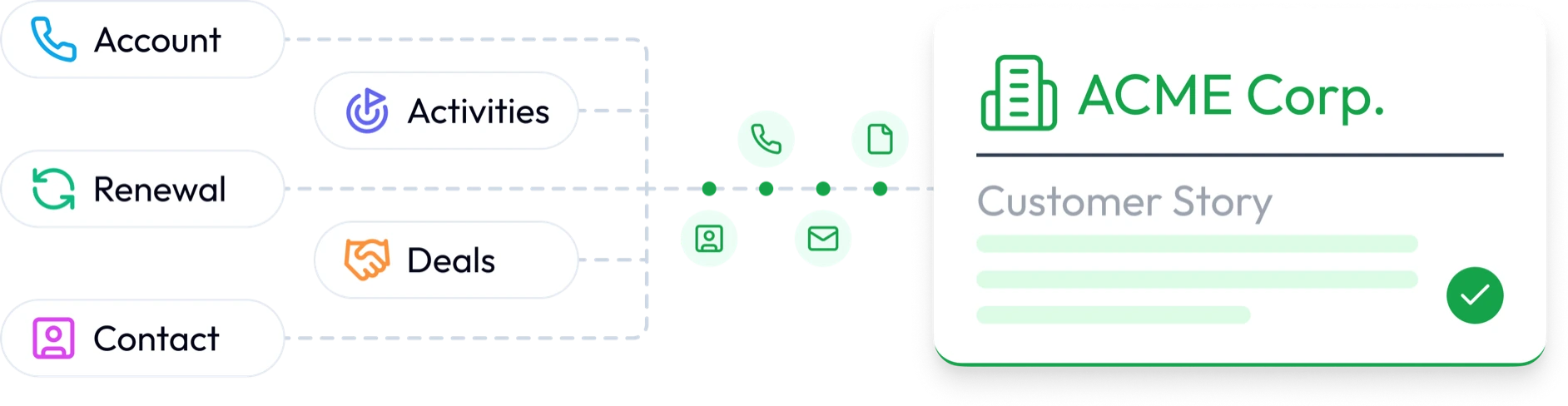
Build the context graph for every deal so every signal lands in one living customer story across accounts, people, activities, renewals, and history.
Hosting
Run the workflow in the cloud with triggers, jobs, retries, approvals, and monitoring the team can rely on every day.
Maintenance
A GTM engineer has to keep the workflow current as your motion changes: mappings, logic, approvals, edge cases, and handoffs.



Why Oliv
Oliv gives agentswhat real revenue work requires.
Your Claude prototype proves the idea. Oliv gives you everything else. Connect your GTM stack, build the revenue context, run the agent, and keep the workflow improving with in-house GTM engineering support.
Raw activity is mapped into account, deal, people, and process context, so the agent knows what changed and what needs attention.
Calls, emails, meetings, CRM fields, docs, and product usage flow into one foundation, enriched and ready to reason over.
Every call, email, meeting, CRM field, document, and product signal flows into one GTM data foundation — ingested, cleaned, enriched, and ready for agents to reason over.
Each agent gets the right tools, memory, permissions, and guardrails for the job — scoped to the task at hand.
Raw activity is mapped into account, deal, people, and process context, so the agent knows what changed and what needs attention.




Bring the workflow you
already proved.
If your Claude workflow is useful but not yet reliable enough for the revenue team, that is the right moment to bring it to Oliv.


The Agentic OS for Revenue Teams
Book a chat with the Founder to discuss your revenue org's AI transformation.