LLMs weren't built to understand your revenue process
Generic models hallucinate. RAG loses context. Oliv took a fundamentally different approach — fine-tuned Small Language Models designed exclusively for the B2B revenue lifecycle.
100x
Cost reduction
< 1%
Hallucinations
100+
Specialized SLMs
< 1 day
Customization time
100x
Cost reduction
< 1%
Hallucinations
100+
Specialized SLMs
< 1 day
Customization time
THE PROBLEM
Generic models + RAG breaks down
Your team sells differently from everyone else. Generic models can't grasp your unique process. Unfortunately, all RevTech companies build on this flawed stack. The cracks are structural.
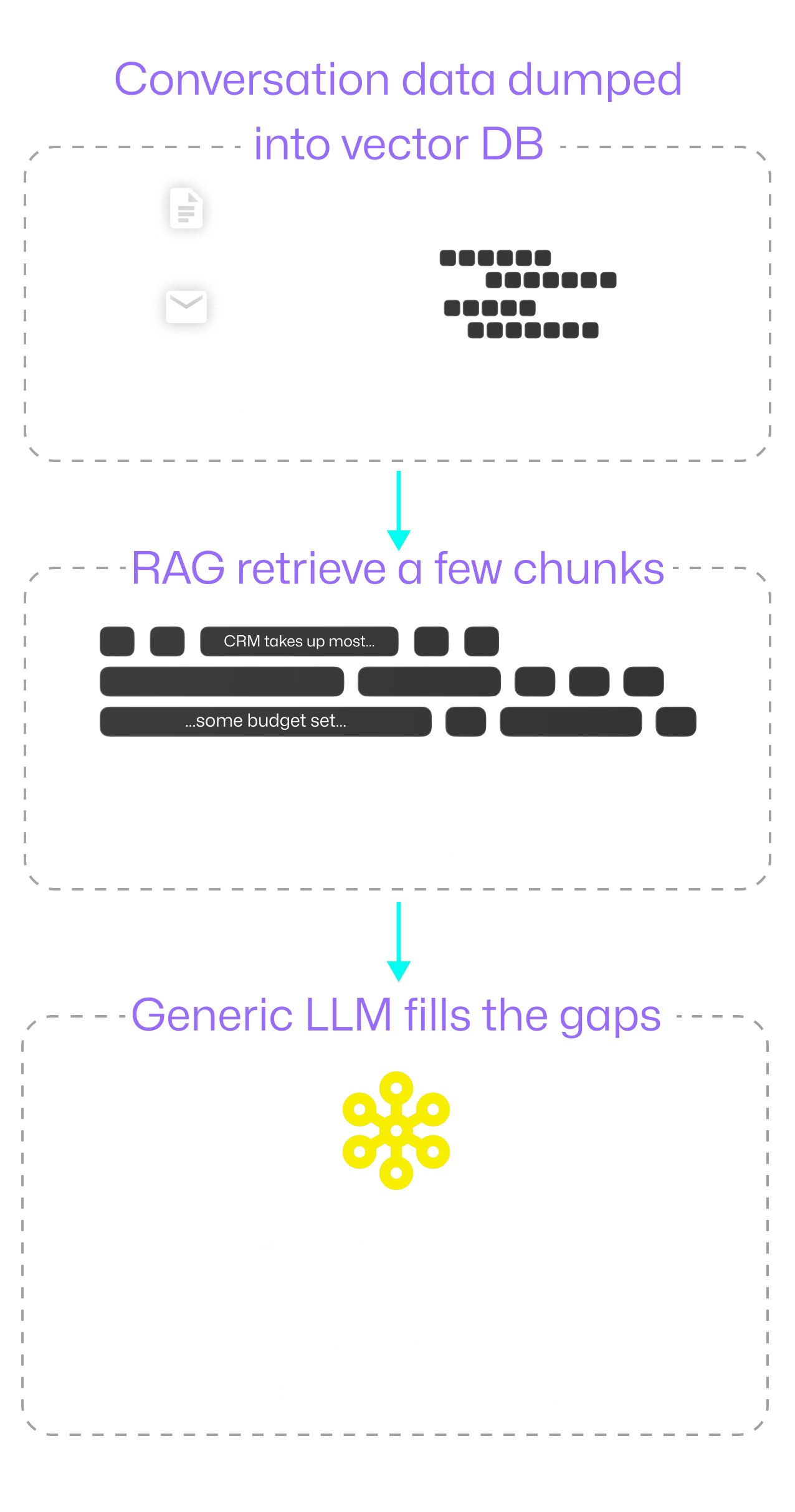
Context gets lost
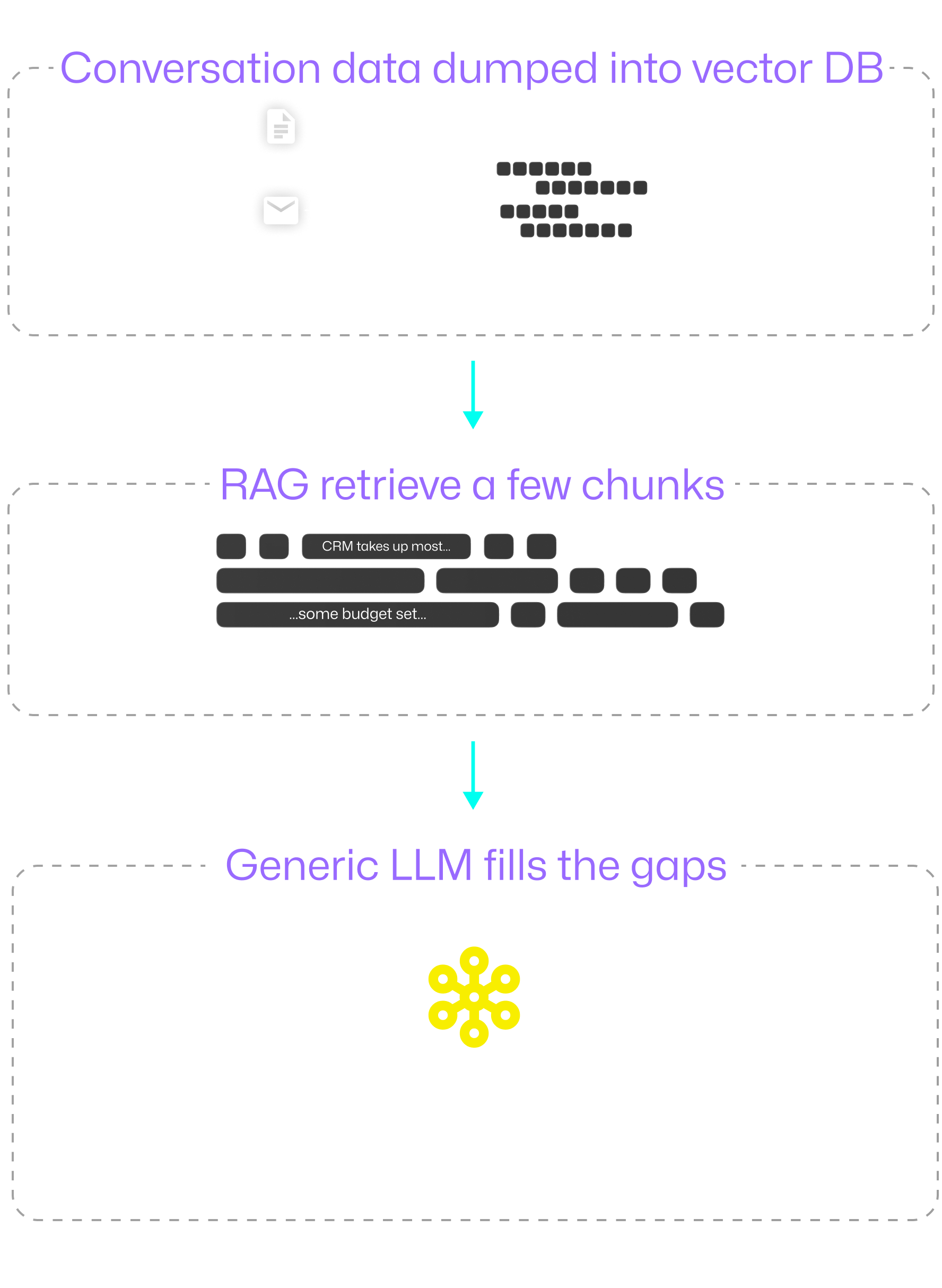
RAG retrieves fragments: a few chunks from a few meetings. It can't reason over 10+ calls, dozens of emails, and the full customer lifecycle simultaneously.
Generic models hallucinate
A trillion-parameter LLM is trained on everything. It "knows" too much, importing context from outside your account and producing confident, wrong answers.
Full context is cost-prohibitive
Passing 5 meeting transcripts to a frontier LLM for every update is unsustainable. At scale, the unit economics collapse entirely.
The Core Difference
Intent Graph built on tailored SLMs
Everybody else chose the fast path. We chose the right one.
Standard Approach
Industry Standard
Outcomes
Misses who said what, no speaker context
Captures out of context pain points not tied to what you sell
Low trust, reps second-guess every output
Hours spent by humans manually reviewing and updating
Oliv's Approach
Oliv SLMs
.avif)
Outcomes
Understands who said what and why it matters
Only surfaces pain points relevant to your solution
Correct insights delivered at the right time — no manual intervention
No additional work created for humans.
How It Works
The insight behind the architecture
Oliv's SLM stack isn't an optimization. It's a fundamentally different way of solving the problem.
The Realization
Revenue teams often ask the same ~100 questions. Across every B2B company we spoke to, 70–80% of the questions asked about an account were identical. What are the pains? Who are the decision makers? What's the budget? What's the decision criterion? The questions are universal. The context is what's unique
What if you built one precise model for each question?
The Build
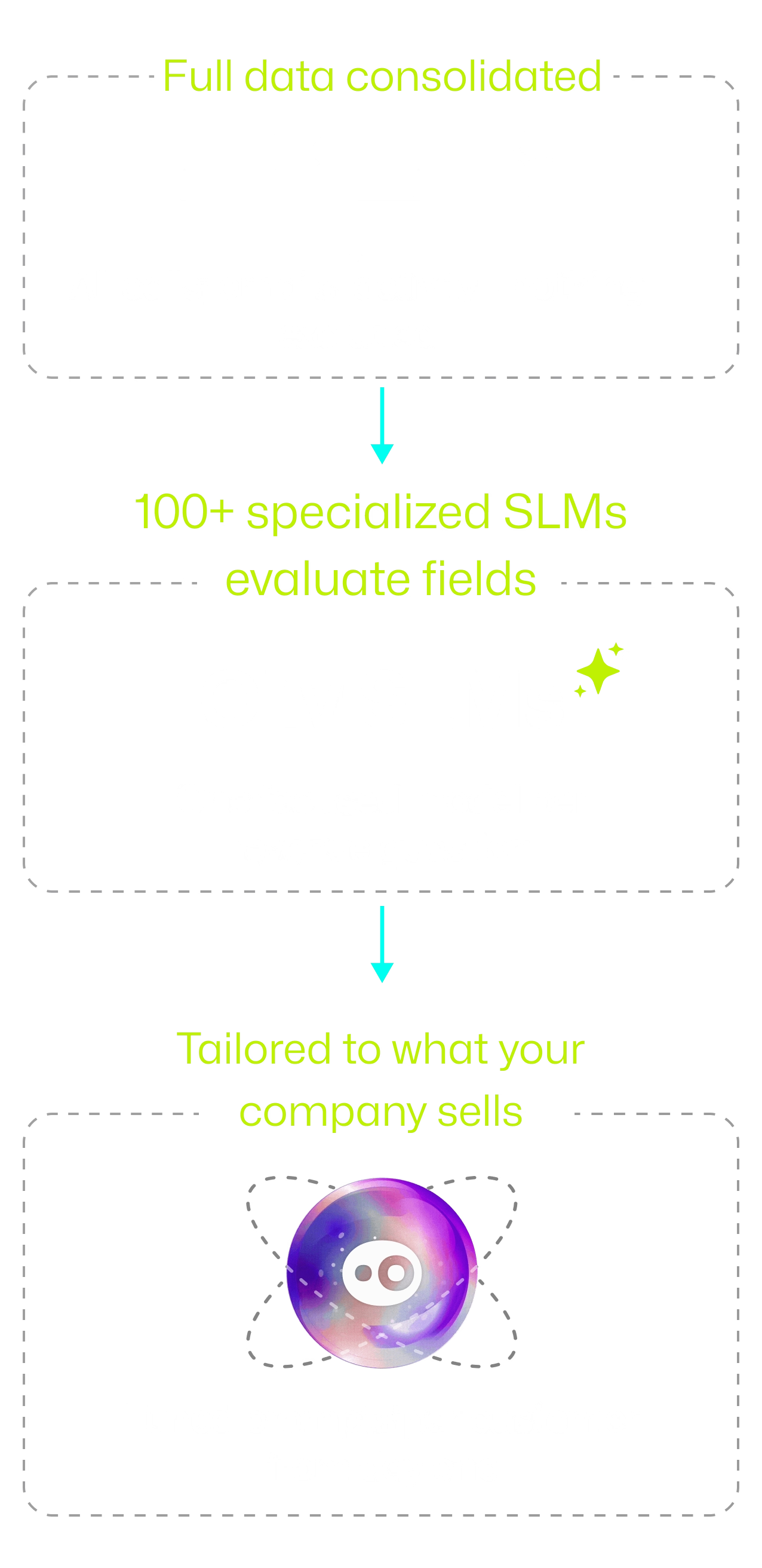
We trained 100+ fine-tuned Small Language Models. For each revenue question, we generated a labeled dataset of 1000+ high-quality examples using frontier LLMs with full context — then use that to fine-tune a lean, focused SLM.
The result: a model that is 1/20th the size of a frontier LLM, but far more accurate on its specific task. No generalist drift. No hallucinations.
The Difference
Each SLM sees the complete history — not fragments. Because SLMs are cheap to run, we can pass the complete history of all transcripts and emails as input. The model doesn't guess from chunks. It reasons over the full picture, the way a top-performing rep would review an account before a call.
The Result
100x cost reduction without sacrificing quality. The focused architecture eliminates the cost overhead of generic models. Keeping a full customer and opportunity scorecard updated goes from expensive and manual to automatic. At enterprise scale, this is the difference between a product that works and one that's economically impossible to build.
1/50th
Size of a frontier LLM
20B parameters vs 1 trillion. Small enough to be fast and affordable. Focused enough to be accurate.
100+
Revenue-specific SLMs
Each one trained on a single question — pains, budget, decision criteria, competitive landscape, and more.
< 1%
Hallucinations in production
Narrow scope eliminates generalist drift. The model can't import context it was never trained to consider.
The SLM Library
A model for every revenue question your team asks
Out-of-the-box models across the entire revenue lifecycle, pre-sales and post-sales. Each one is further tuned to your business context.
Pains & Needs
Budget Availability
Decision Timeline
Decision Criteria
Success Criteria
Champion Identification
Economic Buyer
Competitive Landscape
Next Steps
Risk Signals
MEDDIC Scoring
SPIN Signals
Stakeholder Map
Objection Tracking
Buying Committee
Sentiment Analysis
Follow-up Priority
Forecast Category
Technical Fit
Trigger Events
Persona Fit
Outreach Relevance
ICP Match Score
Initial Interest Signals
First Meeting Readiness
Mutual Action Plan
Proof of Concept Status
Legal & Security Flags
Pricing Sensitivity
Multi-threading Score
Renewal Risk Score
Expansion Signals
Executive Sponsor Health
Product Adoption Gaps
Support Escalation Patterns
NPS Correlation
Time-to-Value Tracking
QBR Readiness
Churn Indicators
Upsell Readiness
Relationship Depth Score
Feature Request Frequency
Stakeholder Change Alerts
Contract Renewal Timeline
MEDDPICC Score
BANT Score
SPICED Score
3 Whys
Challenger Signals
Sandler Signals
AIDA Stage
PESTLE Flags
SWOT Summary
QBR Framework
EBR Scorecard
Competitive Displacement Score
Executive Alignment Score
Deal Velocity
Engagement Frequency
Email Response Patterns
Meeting Attendance Score
Action Item Completion
Champion Engagement
Blockers & Risks
Internal Advocacy Signals
Technical Evaluation Status
Security Review Status
Procurement Stage
Reference Request Readiness
Competitive Win/Loss Signals
Decision Maker Access Score
Negotiation Stage
Contract Risk Flags
Onboarding Readiness
Health Score
Pains & Needs
Budget Availability
Decision Timeline
Decision Criteria
Success Criteria
Champion Identification
Economic Buyer
Competitive Landscape
Next Steps
Risk Signals
MEDDIC Scoring
SPIN Signals
Stakeholder Map
Objection Tracking
Buying Committee
Sentiment Analysis
Follow-up Priority
Forecast Category
Technical Fit
Trigger Events
Persona Fit
Outreach Relevance
ICP Match Score
Initial Interest Signals
First Meeting Readiness
Mutual Action Plan
Proof of Concept Status
Legal & Security Flags
Pricing Sensitivity
Multi-threading Score
Renewal Risk Score
Expansion Signals
Executive Sponsor Health
Product Adoption Gaps
Support Escalation Patterns
NPS Correlation
Time-to-Value Tracking
QBR Readiness
Churn Indicators
Upsell Readiness
Relationship Depth Score
Feature Request Frequency
Stakeholder Change Alerts
Contract Renewal Timeline
MEDDPICC Score
BANT Score
SPICED Score
3 Whys
Challenger Signals
Sandler Signals
AIDA Stage
PESTLE Flags
SWOT Summary
QBR Framework
EBR Scorecard
Competitive Displacement Score
Executive Alignment Score
Deal Velocity
Engagement Frequency
Email Response Patterns
Meeting Attendance Score
Action Item Completion
Champion Engagement
Blockers & Risks
Internal Advocacy Signals
Technical Evaluation Status
Security Review Status
Procurement Stage
Reference Request Readiness
Competitive Win/Loss Signals
Decision Maker Access Score
Negotiation Stage
Contract Risk Flags
Onboarding Readiness
Health Score
+ 80 more
Rapid Tailoring
Built for your business, in under a day.
Every company sells differently. Pains relevant to a DevTools vendor are not the same as pains relevant to a RevOps platform. Oliv's SLMs don't just run out of the box — they get tuned to exactly what your team needs to track within hours of your POV kickoff.
We conduct in-depth research on your company, ingest your enablement materials, and write tailored prompts so each SLM surfaces only the insights that matter for your GTM motion.
Tailored version of Oliv live within 1 day of POV kickoff
Day 0 - POV Kickoff & Research
Deep research on your company
Oliv's agent studies your website, product pages, and positioning to understand exactly what you sell and who you sell to.
Day 1 - Model Tailoring
Custom prompts written for your SLMs
Each SLM gets a tailored prompt that constrains it to surface only signals relevant to your solution — not every pain a prospect mentions.
Week 1+ - Continuous Improvement
Models improve with you
Human feedback and quarterly re-research track new offerings, updated positioning, and new buyer personas as your company evolves.
Oliv captures everything.
No manual data entry. No missed conversations. No blind spots. Just complete, ambient context so your revenue team can close more and your AI can actually do its job.