10 Best AI Tools for Sales Productivity in 2026: Prospecting, Meeting Prep, Note-Taking, and Follow-Up
Written by
Ishan Chhabra
Last Updated :
August 21, 2026
Skim in :
13
mins
In this article
Revenue teams love Oliv
Here’s why:
All your deal data unified (from 30+ tools and tabs).
Insights are delivered to you directly, no digging.
AI agents automate tasks for you.
Thank you! Your submission has been received!
Oops! Something went wrong while submitting the form.
Meet Oliv’s AI Agents
Hi! I’m, Deal Driver
I track deals, flag risks, send weekly pipeline updates and give sales managers full visibility into deal progress
Hi! I’m, CRM Manager
I maintain CRM hygiene by updating core, custom and qualification fields all without your team lifting a finger
Hi! I’m, Forecaster
I build accurate forecasts based on real deal movement and tell you which deals to pull in to hit your number
Hi! I’m, Coach
I believe performance fuels revenue. I spot skill gaps, score calls and build coaching plans to help every rep level up
Hi! I’m, Prospector
I dig into target accounts to surface the right contacts, tailor and time outreach so you always strike when it counts
Hi! I’m, Pipeline tracker
I call reps to get deal updates, and deliver a real-time, CRM-synced roll-up view of deal progress
Hi! I’m, Analyst
I answer complex pipeline questions, uncover deal patterns, and build reports that guide strategic decisions
TL;DR
Oliv AI ranks first because it covers all four jobs in the title, prospecting, meeting prep, note-taking, and follow-up, from one shared account record.
Our rubric weights coverage 30% and output handoff 25%. On a depth-per-task rubric, Gong wins conversation analytics, Clay wins enrichment, and Mindtickle wins training.
Four working point tools often change nothing on the board, because hours return to individuals while handoffs, stale CRM data, and manual forecasts stay exactly where they were.
Automate the work that leaves the rep's desk first: the CRM record, the follow-up, and the handoff. Private research gains help one afternoon, not the quarter.
Demand three things from any write-back: evidence attached to each field, per-field accept or reject, and a durable audit trail readable six months later.
Measure meetings per rep, field completeness at stage gates, follow-up latency, and forecast variance. Hours saved is a feeling; removed work is a number.
Q1. What are the 10 best AI tools for sales productivity in 2026? [toc=1. Best Tools Ranked]
AI for sales productivity means software that automates the non-selling work around a deal: prospect research, meeting prep, call notes, CRM updates, and follow-up. Oliv AI leads this list because it ships agents for all four jobs (Prospector, Meeting Assistant, CRM Manager, and Deal Driver) reading from one shared record. Gong, Clari, Salesforce, HubSpot, Apollo.io, Salesloft, Outreach, Clay, Fireflies.ai, and Mindtickle each own a single job well.
The eleven tools I assessed
Oliv AI
Gong
Clari
Salesforce (Agentforce Sales)
HubSpot
Apollo.io
Salesloft
Outreach
Clay
Fireflies.ai
⭐ How I ranked them
I scored on coverage across the four jobs, and on whether the output of one job feeds the next. That second test is the whole argument here.
If I had scored depth per task instead, a specialist would win every row. Gong would take conversation analytics. Clay would take enrichment. I am not going to pretend otherwise. If depth in one lane is what you need, our breakdown of the best AI sales tools covers a broader vendor set.
🔍 The method, so you can audit it
Every price below traces to a vendor's own page, or to a dated third-party breakdown, and I say which. Every complaint traces to a G2 review with a live link and a date. I dropped the popular "reps only sell 30% of their time" stat because I could not source it to a named publisher.
Comparison table
AI Tools for Sales Productivity Compared, 2026
Tool
Job it owns
Best for
Starting price
Free plan
Rating
Oliv AI
All four, one record
Managers who want the chain, not four logins
$19 per seat per month, $0 platform fee
View-only seats free
⭐⭐⭐⭐⭐
Gong
Conversation analytics
Coaching and deal risk at scale
Not published. Third parties cite $100 to $133 per seat per month plus a $5,000 to $50,000 platform fee
No
⭐⭐⭐⭐
Clari
Forecasting
Weekly forecast roll-up
Not published
No
⭐⭐⭐⭐
Salesforce
CRM of record
Teams standardising on Agentforce
Not published for Agentforce tiers
No
⭐⭐⭐⭐
HubSpot
CRM plus Breeze AI
Mid-market teams already on HubSpot
Free CRM tier published
Yes
⭐⭐⭐⭐
Apollo.io
Prospect data
Building lists fast
Published tiers
Yes
⭐⭐⭐
Salesloft
Sequencing
High-volume outbound
Not published
No
⭐⭐⭐
Outreach
Sequencing
Enterprise outbound governance
Not published
No
⭐⭐⭐
Clay
Enrichment
GTM engineers building flows
Published tiers
Yes
⭐⭐⭐
Fireflies.ai
Note-taking
Note-taking as the only gap
Published tiers
Yes
⭐⭐⭐
1.1 Oliv AI [toc=1.1 Oliv AI]
Oliv AI's agent timeline for account executives shows Deal Driver briefs, CRM Manager field updates, Re-Activator outreach, and Olivia's evening recap covering prospecting, meeting prep, and follow-up.
Oliv AI is an AI-native revenue intelligence and revenue orchestration platform that runs on top of Salesforce or HubSpot. It covers all four jobs in this article's title from a single account record.
🧩 What it actually does
Four agents map to the four jobs. Prospector runs outbound from the company's own first-party context, and the rep reviews and sends the first email.
Meeting Assistant builds the brief from the account's history, not the calendar invite. CRM Manager proposes field updates, and Deal Driver carries the follow-through. Each of these is documented in our guide to Oliv AI agents for sales teams.
⚙️ Key features and implementation
The output of each step becomes the input to the next. That is the difference between four tools and one workflow.
Oliv AI states it runs 70+ integrations and ingests Gong data directly, so shortlisting it does not require ripping out your incumbent first. Agents run on plain-English SOPs your own RevOps lead can edit, which is covered in more detail in our RevOps implementation and admin guide.
💰 Pricing
Oliv AI publishes a per-seat ladder starting at $19 per seat per month, with a $0 platform fee and free view-only seats. In a category where most vendors gate pricing behind a call, a published ladder is checkable. I think that matters more than the number itself.
📅 Product updates
Oliv AI Product Update Timeline
Period
What shipped
Through 2025
Conversation intelligence surface: meetings, emails, and calls captured, with summaries, extracted action items, clipping, and automated coaching scorecards on every meeting.
2026 to date
Agent marketplace with cloneable agents across role categories, plus Oliver (process) and Olivia (rep-facing orchestration), documented on the Oliv agents marketplace.
Signposted next
Wider capture surfaces described on Oliv's context capture page, including shared inter-company Slack channels and consent-first in-person capture via a PLAUD partnership.
✅ Pros and ❌ cons
✅ Covers all four jobs from one record, so nothing gets re-keyed between tools
✅ Field updates arrive with the triggering moment attached, accept or reject per field
✅ Published price ladder and a $0 platform fee
❌ Not the deepest conversation analytics on this list, Gong is
❌ Does not compete on enrichment depth, Clay does that better
⚠️ Architecture claims (model counts, hallucination rates) are Oliv AI's own measurements, so treat them as vendor-stated
👤 Who it is for
Sales managers with reps drowning in prep, notes, and CRM updates. Not the right buy if note-taking is your only gap, Fireflies.ai is cheaper and installs in minutes. For managers weighing the daily workflow specifically, our sales manager AI automation guide goes deeper.
💬 What customers say
"Before Oliv, cleaning up messy CRM fields used to swallow half my week. Oliv fixes the data as it happens." — Darius Kim, Head of RevOps at a Series C company, Oliv AI customer testimonial
Published case study outcomes include Shopify at a 17% shorter sales cycle and Mission Cloud at 15% higher close rates. Both are Oliv AI's own reported figures, and I would ask for the methodology in a demo.
1.2 Gong [toc=1.2 Gong]
Gong's connected graph pulls calls, emails, meetings, CRM records, and external signals from Salesforce, HubSpot, Zoom, and Slack, automating the capture layer behind AI sales productivity.
Gong is a revenue AI platform built around conversation analytics. It owns the note-taking and call-analysis job better than anything else here.
🏆 The genuine strength
Gong was named a Leader in the first Gartner Magic Quadrant for Revenue Action Orchestration, published December 2025. Gong reports it was placed highest in Ability to Execute and furthest in Completeness of Vision among the 12 vendors evaluated.
That is a real credential, and no other tool on this list can claim it. If coaching at scale is your bottleneck, start here, and read our breakdown of Gong's core features before you commit.
🚀 What changed recently
Gong Product Update Timeline
Period
What shipped
Through 2025
Core Revenue AI OS: call capture, transcripts, AI Tracker for trend spotting, AI Composer for engagement strategies, and AI Deal Predictor for automatic deal scoring.
February 2026
Mission Andromeda announced 25 February 2026: Gong Enable with guided AI roleplay, Gong Assistant for conversational querying, Account Console and Account Boards, plus Model Context Protocol client and server support.
Direction indicated
MCP interoperability and post-sales account tooling point toward agent-to-agent integration and expansion coverage beyond new business.
💸 Pricing reality
Gong does not publish pricing. Dated third-party breakdowns put per-seat licences around $1,360 to $1,600 per user per year, tiered by team size. Our own Gong pricing analysis walks through the same contract lines.
On top of that sits a mandatory platform fee of $5,000 to $50,000 per year, charged regardless of seat count. Engage and Forecast are separate modules, listed at roughly $800 and $700 per user per year.
✅ Pros and ❌ cons
✅ Deepest conversation analytics on this list, with strong AI trackers
✅ Gartner Leader placement, December 2025
✅ Mission Andromeda adds roleplay training and MCP support
❌ No published pricing, and a mandatory platform fee before seat one
❌ Forecast and Engage cost extra per user
⚠️ Reviewers report friction pushing data back into Salesforce
👤 Who it is for
Teams over roughly 50 reps with a real enablement function and budget for a platform fee. Skip it if your bottleneck is CRM hygiene rather than call coaching, and compare the trade-offs in our guide to Gong alternatives.
💬 What reviewers say
"I appreciate how Gong organizes all our chats, videos, and audio with clients into a single source... I found the AI tracker setup to be quite difficult... I cannot download all the data myself unless we upgrade the plan." — Verified reviewer, "Challenging Setup with Valuable AI Tracking", 3 stars, Gong G2 Verified Review, 3 Oct 2025
"Being able to sequence our steps, along with integration with Nooks/Salesforce... limitations of getting data back into salesforce." — Verified reviewer, "Great step sequencing and Nooks/Salesforce integration", 3 stars, Gong G2 Verified Review, 21 May 2026
"Gong Engage is awful in every single way compared to outreach... sequencing is difficult to create and track, nothing is robust or scalable." — Verified reviewer, "Compared to Outreach....doesn't compare", 1.5 stars, Gong G2 Verified Review, 9 Jun 2025
1.3 Clari [toc=1.3 Clari]
Clari Guide's AI workspace lists cadences, objectives, and recommended next steps like send proposal or follow up, showing how AI for sales productivity drives guided deal execution.
Clari is a revenue platform built around forecasting. It owns the roll-up job, not the four rep-facing jobs in this article's title.
📊 What it does
Clari pulls opportunity data from your CRM and turns it into a weekly forecast view. Managers use it to inspect pipeline and call the number. Our breakdown of Clari's core features covers how that view is assembled.
Clari merged with Salesloft on 3 December 2025, with Steve Cox named CEO of the combined company. That merger matters for buyers, and I will come back to it under Salesloft.
📅 Product updates
Clari Product Update Timeline
Period
What shipped
Through 2025
Forecast roll-up, pipeline inspection views (Flow View, Waterfall View), opportunity analysis, and Salesforce sync, per reviewer descriptions on Clari's G2 profile.
December 2025 to April 2026
Merger closed 3 Dec 2025, adding Revenue Cadences, an AI Action Hub, and deal-health agents. The April 2026 release connected Clari Forecast into Salesloft's execution layer plus an MCP Server.
Expected next
Deeper feature integration sits on the 2026 roadmap but has not shipped in full, and platform unification was described as happening "over the coming years".
✅ Pros and ❌ cons
✅ Clean, fast weekly forecast workflow
✅ Easy Salesforce integration for forecast data
❌ Conversation intelligence is thin compared to Gong
❌ Reviewers report weak CRM write-back
⚠️ Seven months post-merger, interfaces were still separate
👤 Who it is for
VPs and RevOps leads who need a forecast system. It will not give your AEs back their Tuesday. If forecast accuracy is the real problem, our guide to AI sales forecasting software compares the field.
💬 What reviewers say
"The CRM writeback is not good; we cannot send MEDDIC values back to Salesforce or update fields in Salesforce from the conversation intelligence. The AI is not as flexible as we need it to be." — Verified reviewer, 1.5 stars, Clari G2 Verified Review, 13 Jul 2026
"I enjoy being able to forecast easily without having to add up manually... UI sometimes not intuitive enough." — Verified reviewer, 3 stars, Clari G2 Verified Review, 17 Dec 2025
Salesforce is the CRM of record for most enterprise revenue teams. Sales Cloud is now branded Agentforce Sales.
🤖 What changed under the hood
Salesforce has pushed agents into the seller workflow rather than shipping a separate app. Sales Workspace, prospecting agents, and Slack delivery are the shape of it, and our review of Agentforce for Sales features walks through each surface.
Momentum now captures conversations from Zoom, Google Meet, and Gong directly into Salesforce. Your CRM is becoming a capture surface, not just a database.
Agentforce for Sales Lead Generation qualified inbound visitors autonomously. Pipeline Management enhancements drafted follow-up emails and triggered tasks in Salesforce and Slack.
Spring and Summer '26
Sales Workspace hub went live. Summer '26 added MEDDIC scoring in Pipeline Inspection, Slack First Sales, Momentum conversation capture, and field-level control over autonomous record updates.
Expected next
Einstein Activity Capture data is moving onto the core Salesforce platform, with Activity 360 reporting and Activity Metrics scheduled for retirement.
✅ Pros and ❌ cons
✅ Agents sit inside the system of record, so no new login
✅ Field-level control over which values agents may update autonomously
❌ Rule-based activity matching struggles with duplicate accounts
❌ Consumption pricing means logic loops cost money
⚠️ Agent quality depends entirely on CRM data hygiene
👤 Who it is for
Enterprises already standardised on Salesforce with an admin team to configure agents. Skip if your CRM is full of duplicates and nobody owns cleanup, and read our analysis of Agentforce limitations for B2B revenue teams first.
💬 What reviewers say
"If a list has 2000 contacts, it runs smoothly up until around 200 contacts, but as the number of contacts increases, the tab starts to lag. Additionally, there's often a problem with data duplication." — Verified reviewer, 4.5 stars, Agentforce Sales G2 Verified Review, 27 Jul 2026
1.5 HubSpot [toc=1.5 HubSpot]
HubSpot is the CRM plus its Breeze AI layer. For mid-market teams already on HubSpot, it is the cheapest way to get agents into the workflow.
💡 What Breeze actually does now
Breeze Agents research accounts, draft outreach, and analyse data inside the CRM record. Smart Deal Progression reads call transcripts against CRM history to suggest deal updates and follow-ups.
Oliv AI runs on top of HubSpot as a connected system, so this is not an either-or choice for most teams. I would treat HubSpot as the record and judge any AI layer on what it writes back, which is the same test we apply in our guide to integrating sales automation in your CRM.
💰 Pricing
HubSpot moved Breeze agents to outcome-based pricing on 14 April 2026. Customer Agent bills at 50 credits per resolved conversation (about $0.50), and Prospecting Agent at 100 credits per recommended lead (about $1.00).
Both require Pro or Enterprise, with a 28-day free trial. A free CRM tier still exists underneath.
📅 Product updates
HubSpot Breeze Product Update Timeline
Period
What shipped
Through 2025
Breeze Copilot and first-generation agents embedded in Smart CRM, with prospecting and content assistance across Sales and Marketing Hub.
April 2026
Spring 2026 Spotlight shipped 100+ updates: rebuilt Prospecting Agent with buying-signal detection and buying-committee mapping, Smart Deal Progression, HubSpot AEO, plus outcome-based agent pricing.
Expected next
Customer Health Agent, Company Research Agent, and Closing Agent are listed in beta. Developers can now ship agent tools Breeze Agents can call, with platform releases in March and September.
✅ Pros and ❌ cons
✅ Free CRM tier and published pricing mechanics
✅ Prospecting Agent now maps whole buying committees
❌ Reviewers report Breeze lag and failed content insertion
❌ Search degrades on large databases with duplicates
⚠️ Per-outcome billing needs usage governance from day one
👤 Who it is for
Mid-market teams already running HubSpot who want AI without a second vendor. Less suitable if you need deep customer conversation analytics.
💬 What reviewers say
"Breeze AI has been a game changer for building lead lists fast... Breeze AI can lag, sometimes it freezes the page I'm on until the response loads, and occasionally it won't insert generated content into my records properly." — Verified reviewer, 5 stars, HubSpot Sales Hub G2 Verified Review, 9 Jun 2026
"The AI features feel obsolete. The search feature gives inaccurate results when working with a large database." — Verified reviewer, 3 stars, HubSpot Sales Hub G2 Verified Review, 18 May 2026
1.6 Apollo.io [toc=1.6 Apollo.io]
Apollo.io is a prospect database with sequencing attached. It owns the prospecting job, specifically the data half of it.
🔎 What it does
Apollo combines a contact database, filters, and outbound sequences in one tool. Reps build lists and start emails without leaving the app.
This is third-party data, which is a different category from first-party account context. Both matter, and I would not ask one to replace the other. Our comparison of the best sales intelligence platforms sets out where each category earns its budget.
📅 Product updates
Apollo.io Product Update Timeline
Period
What shipped
Through 2025
Contact and company database, sequences, dialer, Chrome extension, and CRM sync, documented in Apollo's release notes.
March to August 2026
AI Assistant hit general availability for free and paid users, alongside waterfall enrichment across 20+ partner sources, a saved records hub, and video-call recording consent handling. A ChatGPT app followed.
Expected next
Apollo is extending MCP into Claude, ChatGPT, Cursor, and Replit, with custom-field read and write, mailbox guardrails, and Snowflake Secure Data Sharing for enterprise queries.
💰 Pricing
Apollo publishes tiers including a free plan. Advanced dialer and website visitor tracking are formalised as $119 per month team add-ons.
✅ Pros and ❌ cons
✅ Fast list building with a large database
✅ Free tier, published pricing, and a real MCP surface
❌ Data accuracy complaints are persistent and specific
❌ Reviewers report HubSpot and Chrome extension breakage
⚠️ Job-change triggers have overwritten billing contact emails
👤 Who it is for
SDR teams building volume lists. Not the tool for meeting prep or CRM hygiene.
💬 What reviewers say
"The integration with HubSpot and Chrome Extension broke late summer/fall of 2025 causing us to be unable to sync contacts to sequencing directly from HubSpot." — Verified reviewer, Apollo.io G2 Verified Review, 18 Feb 2026
"The information is incorrect. It's wrong more often than not. When we look up our own company, it's missing most of our senior leadership." — Verified reviewer, Apollo.io G2 Verified Review, 30 Sep 2025
1.7 Salesloft [toc=1.7 Salesloft]
Salesloft is a sales engagement platform, now part of the merged Clari group. It owns sequencing.
🔗 What the merger changed
Salesloft powers top of funnel with the Account Research Agent, Person Research Agent, and Ask Salesloft Agent. Clari carries conversion and close.
The first joint release landed in April 2026, connecting Clari Forecast into Salesloft's execution layer. Buyers should ask directly where their contract sits, and our note on revenue tech stack consolidation costs covers what that renewal usually looks like.
📅 Product updates
Salesloft Product Update Timeline
Period
What shipped
Through 2025
Cadences, templates, dialer, and CRM sync, with Drift acquired and later slated for sunset.
December 2025 to April 2026
The merger with Clari closed 3 Dec 2025, adding Account Research, Person Research, and Ask Salesloft agents. April 2026 shipped a native Forecast connection plus an MCP Server.
Expected next
A unified interface remains unshipped. Pricing has moved upward for teams wanting the bundled experience, per a mid-2026 merger review.
✅ Pros and ❌ cons
✅ Cadences keep high-volume follow-up on schedule
✅ New research agents feed the top of funnel
❌ Reviewers describe setup as cumbersome and the UX as clunky
❌ Dialer speed and extension staleness come up repeatedly
⚠️ Roadmap uncertainty through integration
👤 Who it is for
Outbound teams with a dedicated ops owner. Not a fit for a manager wanting fast, low-config wins.
💬 What reviewers say
"Salesloft helps organize outreach at scale and keeps follow-ups from falling through the cracks... Integrating Salesloft came with a lot of challenges, and even now, it feels like the platform still has some kinks." — Verified reviewer, 2.5 stars, Salesloft G2 Verified Review, 22 Jul 2025
"The UX is horrible, the features don't work, it's not clear, I waste a lot of time on the software." — Verified reviewer, 0.5 stars, Salesloft G2 Verified Review, 5 Jan 2026
1.8 Outreach [toc=1.8 Outreach]
Outreach is a sales execution platform that has rebuilt itself around agents. It owns enterprise sequencing with governance.
🚀 What shipped in 2026
The April 2026 release moved the Meeting Prep Agent to general availability. Deal Agent now pushes AI-suggested field updates into Slack for reps to accept or edit.
Agent Studio lets ops teams build and schedule custom agents on a visual canvas. Outreach Knowledge grounds agent responses in approved company content, which is the same grounding problem covered in our piece on agentic AI implementation and RevOps data architecture.
📅 Product updates
Outreach Product Update Timeline
Period
What shipped
Through 2025
Sequences, Kaia conversation intelligence, and the first Revenue, Research, and Deal agents.
February to April 2026
Meeting Prep Agent moved beta to GA, Deal Agent gained automatic updates for custom methodologies, and Research Agent added scheduled refresh. Spring 2026 added Omni, Agent Studio, Knowledge, Deal Alerts, and Smart Kaia Coach.
June 2026 onward
Outreach launched an MCP Client and Agentic Ecosystem marketplace, pairing it with its MCP Server for cross-stack agent operation.
✅ Pros and ❌ cons
✅ Multi-channel sequencing with real governance controls
❌ Dense interface, with onboarding measured in weeks
❌ Salesforce sync errors and duplicate contacts recur
⚠️ Importing contacts from Salesforce draws sharp criticism
👤 Who it is for
Enterprise outbound teams with enablement support. Avoid if you want a rep productive in a day.
💬 What reviewers say
"Precision Sequencing & Automation... The AI-driven Kaia meeting assistant feels like a major win for managers... The interface is extremely dense... Onboarding a new hire can take weeks rather than days." — Verified reviewer, 4 stars, Outreach G2 Verified Review, 29 Apr 2026
"Sometimes it does not sync well with Salesforce. The calls don't get synced to Salesforce, which is the issue we're still working on even with Outreach support's help." — Verified reviewer, 4 stars, Outreach G2 Verified Review, 10 Apr 2026
1.9 Clay [toc=1.9 Clay]
Clay is a GTM data and enrichment platform. It owns enrichment depth, and nothing on this list beats it there.
🧪 What it does
Clay works like a spreadsheet where each column runs an enrichment or an AI research step. You control the process column by column.
Claygent agents research the web and write structured output back into your table. Every agent decision comes with a reasoning trace, which auditors like, and which our framework for AI CRM trust and governance evaluation treats as a hard requirement.
📅 Product updates
Clay Product Update Timeline
Period
What shipped
Through 2025
Claygent web research, waterfall enrichment across providers, Magic Column, and CRM integrations, tracked on the Clay changelog.
May to August 2026
Claygent Builder launched May 2026 with natural-language agent creation and version control, free across tiers. Claygent Navigator added vision-based form filling with step-by-step replay.
Expected next
Account Research Agents remain in beta for Enterprise, Growth, and Launch plans, synthesising CRM, warehouse, and Gong call signals in Audiences.
✅ Pros and ❌ cons
✅ Deepest enrichment control on this list
✅ Full reasoning trace per agent decision
❌ Signal refresh can run only once a day
❌ Steep learning curve for non-technical reps
⚠️ Account Research Agents are still beta and plan-gated
👤 Who it is for
GTM engineers and RevOps builders. Not a tool you hand to an AE on Monday.
💬 What reviewers say
"I like that Clay has a structured way to go through, column by column, to really control exactly how you're enriching data... Clay's AI assistant could be improved." — Verified reviewer, 4 stars, Clay G2 Verified Review, 10 Mar 2026
"Sometimes with Clay, it's hard to run live signal flows, as any signal is captured only once a day." — Verified reviewer, Clay G2 Verified Review, 29 Apr 2026
1.10 Fireflies.ai [toc=1.10 Fireflies.ai]
Fireflies.ai is a meeting note-taker. If note-taking is your only gap, it is the cheapest honest answer on this list.
⏰ What it does
Fireflies joins calls, transcribes them, and produces summaries. Speaker attribution is genuinely good, which matters for assigning actions. Our roundup of AI note-taking tools compares it against the rest of that category.
It does not resolve a meeting to the right opportunity in a messy CRM. That gap is the whole reason platform tools exist.
💰 Pricing
Fireflies publishes four tiers on its own pricing page: Free at $0, Pro at $10, Business at $19, and Enterprise at $39 per seat per month on annual billing. The free plan is permanent, not a trial.
Free includes unlimited transcription and summaries, with storage capped and no CRM integration. AI credits gate the advanced features.
📅 Product updates
Fireflies.ai Product Update Timeline
Period
What shipped
Through 2025
Bot-based recording, transcription in 69+ languages, AskFred querying, AI Soundbites, and CRM sync on paid tiers.
2026 to date
Credit-metered AI Skills for tailored summaries, with 20 monthly credits on Free and 50 on Enterprise.
Expected next
Voice Agents that run calls on your behalf now sit behind paid tiers, signalling movement from passive capture toward active call handling.
✅ Pros and ❌ cons
✅ Installs in minutes and costs nothing to start
✅ Strong speaker attribution on video calls
❌ No CRM integration on the free plan
❌ Storage caps fill quickly with regular use
⚠️ AI credit metering makes heavy use unpredictable
👤 Who it is for
Individuals and small teams who need notes, nothing more. Wrong choice if the output has to reach your CRM, where CRM data quality automation becomes the real requirement.
Q2. How were these tools scored, and what should your own checklist look like? [toc=2. Scoring and Checklist]
Five criteria weighted to 100: Coverage Across the Four Jobs 30%, Output Handoff Between Steps 25%, CRM Write-Back Accuracy and Auditability 15%, Verified User Reviews 15%, and Pricing Transparency and Setup Effort 15%. Scores convert to stars in twenty-point bands. The rubric is deliberately biased toward chain continuity, which is why a better single-task tool can score lower here. I would rather say that plainly than bury it.
The five criteria, and why each earns its weight
Coverage carries the most weight because the article's promise is four jobs, not one. A tool that nails note-taking and nothing else is not answering the question a sales manager asked.
Handoff carries the second-highest weight for a simpler reason. It is the only criterion a stack of point tools cannot fix by buying one more tool, which is the same argument we make in our guide to reducing sales tech stack costs.
📏 The remaining three
Write-back accuracy earns 15% because a field nobody trusts is worse than a blank field. Auditability sits inside that score, not beside it.
Verified reviews and pricing transparency split the last 30%. Oliv AI publishes a per-seat ladder starting at $19 with a $0 platform fee, which is checkable, while several vendors here quote only on a call.
Scored results
Vendor Scores and Star Ratings
Vendor
Score
Stars
Oliv AI
92
⭐⭐⭐⭐⭐
Gong
78
⭐⭐⭐⭐
Clari
72
⭐⭐⭐⭐
Salesforce
66
⭐⭐⭐⭐
HubSpot
64
⭐⭐⭐⭐
Apollo.io
60
⭐⭐⭐
Salesloft
58
⭐⭐⭐
Outreach
55
⭐⭐⭐
Clay
52
⭐⭐⭐
Fireflies.ai
48
⭐⭐⭐
Mindtickle
45
⭐⭐⭐
⚠️ Change one number and the ranking flips
Move Coverage down to 10% and raise a new criterion called Depth Per Task to 45%. Gong takes conversation analytics outright, Clay takes enrichment, and Mindtickle takes training.
That is not a hypothetical. It is the rubric I would use if you have one bottleneck instead of four, and I think plenty of teams do. Our revenue intelligence platform comparison for RevOps runs that alternative weighting in full.
Your own eight-line demo checklist
Run these questions against any vendor, including the ones I ranked. Ask them with a shared screen open, not over email.
Which of the four jobs does this cover without a second product?
Show me the output of step one becoming the input to step two.
When you update a CRM field, what evidence is attached to it?
Can a rep reject a single field without turning off the whole agent?
What is the per-seat price, and is there a platform fee before seat one?
Are view-only seats billed?
What does week one look like for a rep, not for an admin?
What is your weekly active user rate across existing customers?
🔍 Why question eight matters most
G2 and Vivun's 2025 research on AI adoption in sales found reps hit fatigue past roughly three tools, even while daily usage runs high. A tool nobody opens is a subscription, not a system.
My rule is simple. Retire any AI tool under 40% weekly active rep usage after 60 days, and stop paying to feel modern. Our revenue intelligence ROI calculator gives you the arithmetic for that call.
Oliv AI scores 92 on this rubric because all four agents write to one shared record, and field updates carry the moment that triggered them. On a depth-per-task rubric it does not lead every row. Gong wins conversation analytics, Clay wins enrichment, and Mindtickle wins training.
Q3. Why do four working AI tools often change nothing on the board? [toc=3. The Productivity Paradox]
Because the hours came back to individuals while the organization kept its handoffs, its stale CRM, and its hand-assembled forecast. Adoption is near-universal and satisfaction is not. Gartner forecasts AI agents outnumbering human sellers ten to one by 2028, yet fewer than 40% of sellers saying agents improved their productivity. Four working tools, four sets of returned hours, and no line moves.
Start with what is already happening on your team
Your reps already use ChatGPT and a free note-taker. Nobody asked them to. They found it, installed it, and it works.
That is more adoption than most rollouts achieve. I am not going to pretend otherwise, and neither should any vendor pitching you.
🚧 Then draw the line
Every one of those workflows is private. Nobody can audit it, standardize it, or hand it over when the rep leaves in March.
None of them writes to the system the rest of the team depends on. Ask Oliv AI's agents to update a deal and the change lands on the shared account record, not in someone's chat history.
The paradox nobody in this category prints
Adoption is not the problem anymore. Gartner's own forecast pairs a ten-to-one agent ratio with fewer than 40% of sellers reporting a productivity gain.
Salesforce's State of Sales 2026 survey of over 4,000 sellers found 54% have used agents, with nearly nine in ten planning to by 2027. Adoption up, satisfaction flat. That gap is the story, and it is the one our piece on what AI agents can actually do for your team was written to answer.
💸 The reinvestment gap
Hours saved are not hours banked. Research shared alongside the 2026 State of Sales cycle found most organizations fail to redeploy the time AI returns, while those that do are far likelier to beat conversion goals.
I could be reading this too strongly, but the pattern matches what surfaces in Oliv AI's customer conversations. Teams celebrate the saved hour and never ask where it went.
Tool sprawl has a specific breaking point
G2 and Vivun found 73% of reps use AI daily and save real time, then hit fatigue past three or more tools. The same research showed top-of-funnel skew producing 35% more pipeline but only 10% to 20% more wins.
More pipeline, barely more revenue. That is what individual efficiency looks like on a board slide, and it is why revenue tech stack consolidation keeps landing on the CFO's desk.
🧩 The reps-as-operators problem
A prospect put it to me directly on a call. How do we make a seller a really great seller, instead of an AI expert building their own private systems?
Oliv AI's read is that the standard advice gets this backwards. Buying reps more tools makes them operators, and operators are not what you hired.
The thesis, stated flat
Individual productivity tools work. That is the problem.
Individual efficiency without organizational efficiency is not a smaller version of the goal. It is a different outcome, and it shows up as four happy reps and an unchanged forecast.
Oliv AI runs its agents against a continuously updated context graph of every account and opportunity, so the work product survives the rep's last day. That is the only real difference between a tool your rep uses and a system your team owns.
Q4. Which tasks should you automate first, and how many hours does that actually return? [toc=4. Sequencing and Hours Saved]
Automate the work that leaves the rep's desk first: the CRM record, the follow-up, and the handoff. Someone downstream is waiting on those. Salesforce's State of Sales 2026 survey of over 4,000 sellers puts selling at about 40% of a rep's time, with agent users expecting research time to fall by roughly a third. Faster private research helps one afternoon. Only the outbound work compounds.
The sequencing rule
Rank your automations by who receives the output. If the answer is "only the rep," it goes second.
Oliv AI's CRM Manager proposes each field with the source moment attached, so the update reaches the forecast rather than a rep's notebook. That is the test I would apply to any vendor, and it is the backbone of CRM data quality automation for RevOps.
📊 What the numbers actually support
Here is what survives sourcing, with publisher and date attached.
Sourced Benchmarks on AI and Sales Productivity
Finding
Publisher
Date
Reps sell about 40% of the time
Salesforce State of Sales, 4,000+ sellers
2026
Agent users expect research time down 34%, email drafting down 36%
Salesforce State of Sales
2026
56% of sales pros use AI daily; daily users 2x likelier to exceed target
LinkedIn, The ROI of AI
2025
69% report sales cycles shortened by about a week
LinkedIn, The ROI of AI
2025
51% of leaders cite disconnected systems as the AI blocker
Salesforce State of Sales
2026
What I am not printing, and why
Three statistics circulate constantly in this category. Reps sell only 30% of the time. Ninety percent of agentic AI projects fail. Sixty-five percent of CRM data is inaccurate.
I could not trace any of them to a named, dated publisher with a sample size. Oliv AI's own site carries versions of two, and I still would not put them in an article you might screenshot.
⚖️ The honest counterargument
Point tools are cheap. They arrive in weeks, adopt bottom-up, and skip procurement entirely. Platform decisions die in legal review.
Under roughly fifteen reps with no ops function, four good point tools is genuinely the right answer. Buy Fireflies, buy Apollo, and move on. Our guide to revenue intelligence for small sales teams covers that scenario properly.
When that stops being true
The moment a forecast is assembled by hand from what reps remember, the stack becomes four data islands. Reviewers describe exactly this failure across vendors.
Oliv AI resolves each captured conversation to a single opportunity before any agent acts, which matters when an account carries duplicate records. Nobody owns that step in a four-tool stack.
💬 What reviewers report about the handoff
"The CRM writeback is not good; we cannot send MEDDIC values back to Salesforce or update fields in Salesforce from the conversation intelligence." — Verified reviewer, 1.5 stars, Clari G2 Verified Review, 13 Jul 2026
"Sometimes it does not sync well with Salesforce. The calls don't get synced to Salesforce, which is the issue we're still working on." — Verified reviewer, 4 stars, Outreach G2 Verified Review, 10 Apr 2026
"There's often a problem with data duplication, where a single contact gets duplicated multiple times or a single company appears under different names in the CRM." — Verified reviewer, 4.5 stars, Agentforce Sales G2 Verified Review, 27 Jul 2026
Your Monday action
Baseline two weeks before you buy anything. Track prep minutes, note-taking minutes, follow-up latency, and CRM completeness at stage gates. Pair that with the sales productivity metrics your VP already reviews.
Oliv AI publishes customer outcomes in those terms, including Swanky cutting account research from two hours to fifteen minutes. Whatever tool you pick, own a number nobody in the QBR can dispute.
Q5. Will reps actually use it, and can you trust it to write to the CRM? [toc=5. Adoption and CRM Write-Back]
Reps abandon anything whose first benefit accrues to their manager. That is why prep and follow-up are the right first automations, and CRM hygiene should be the by-product rather than the pitch. On write-back, demand three things: every proposed field change cites the moment in the call that triggered it, the rep accepts or rejects per field, and the audit trail survives.
The fifth login is a real cost
Your reps already have a CRM tab, a dialer, a note-taker, and Slack. A fifth tool is not neutral. It is another place to check, another password, and another thing to blame when a deal slips.
I have watched rollouts die in week six for exactly this reason. Nobody announces it. Usage just drifts to zero.
⏰ What a Tuesday has to look like
An AE opens their laptop at 8:40 for a 9:00 call. The brief is already there: what changed since last week, who is new on the buying committee, and the two open objections.
Oliv AI's Meeting Assistant builds that brief from the account's own history rather than the calendar invite. Value lands before anyone asks the rep for anything, which is the standard we set out in our guide to an AI meeting preparation tool.
The three-part write-back standard
Anything touching a CRM field has to clear all three of these. Not two.
Evidence. Each proposed value points to the sentence, email, or call moment that produced it.
Per-field control. The rep accepts or rejects one field without disabling the agent.
Durable audit trail. Who changed what, when, and on what basis, still readable in six months.
📋 Why per-field control decides adoption
An all-or-nothing agent gets switched off the first time it guesses wrong on close date. A per-field agent survives the same mistake.
Oliv AI's CRM Manager proposes each update with its source moment attached, and states 95%+ field accuracy against roughly 60% for manual entry. That accuracy figure is Oliv's own measurement, so treat it as a claim to test in a pilot.
Where activity matching quietly breaks
Rule-based activity capture matches emails and meetings to records using domain and address logic. It works until your CRM has duplicates, and every CRM over three years old has duplicates. Our note on CRM data strategy and revenue predictability covers what that costs a forecast.
Salesforce documents that Einstein Activity Capture data is moving onto the core platform, with Activity 360 reporting and Activity Metrics scheduled for retirement. Plan for that migration rather than discovering it.
⚠️ Data, not model quality, gates the return
Salesforce's State of Sales 2026 found 51% of sales leaders name disconnected systems as the blocker to AI initiatives. The model is rarely the problem, a point we develop in our piece on agentic AI implementation and RevOps data architecture.
Also, treat AI-SDR claims sceptically across every vendor here. Full-replacement deployments largely reverted to human-in-the-loop through late 2025.
💬 What reviewers report
"Being able to sequence our steps, along with integration with Nooks/Salesforce... limitations of getting data back into salesforce." — Verified reviewer, 3 stars, Gong G2 Verified Review, 21 May 2026
"Integrating Salesloft came with a lot of challenges, and even now, it feels like the platform still has some kinks. I often have trouble logging meetings." — Verified reviewer, 2.5 stars, Salesloft G2 Verified Review, 22 Jul 2025
Five questions for the demo call
Ask these with a shared screen, not over email.
Show me a field update and its source evidence.
Reject one field. What happens to the rest?
Where does the audit trail live, and who can read it?
How do you handle two open opportunities on one account?
What does day one look like for a rep, not an admin?
Oliv AI delivers the pre-call brief before it asks a rep to confirm a single field, which is the order that decides whether a tool survives quarter two. Sequencing rep value first is not a courtesy. It is the adoption strategy.
Q6. What does it cost per rep, who has to approve it, and what compliance applies? [toc=6. Cost, Approvals, Compliance]
Per-seat list price is the least useful number in the quote. Platform fees, add-on forecast and engagement modules, and paid view-only seats move the total more. A note-taker is a credit-card purchase. Anything writing to the CRM needs RevOps and IT. From 2 August 2026, EU AI Act Article 50 transparency duties apply, and eleven US states clearly require all-party consent for recorded calls.
The four lines that move your total
Seat price is line one. Line two is the platform fee charged before a single seat.
Line three is modules sold separately, usually forecasting and engagement. Line four is the seats nobody counts, meaning managers and CS who only need to look.
💰 What each vendor actually charges
Published Pricing, Platform Fees, and Free Plans by Vendor
Vendor
Published price
Platform fee
Free plan
Oliv AI
$19 to $79 per seat per month, published ladder
$0, per Oliv's own comparison
View-only seats free
Gong
Not published. Third parties cite $1,360 to $1,600 per user per year
$5,000 to $50,000 per year
No
Fireflies.ai
$0, $10, $19, $39 per seat per month, annual
None
Yes, no CRM sync
HubSpot
Breeze billed per outcome: about $0.50 per resolved conversation, $1.00 per recommended lead
Pro or Enterprise required
Free CRM tier
Apollo.io
Published tiers, plus $119 per month dialer and visitor add-ons
Gong reviewers report data export gated behind a plan upgrade, which turns a routine task into a renewal conversation. Oliv AI publishes a $0 platform fee and free view-only seats, which is checkable in a category that mostly quotes on a call. Our breakdown of how to reduce sales tech stack costs works through the same maths.
Expense it, or implement it
A note-taker for one rep is an expense claim. Nobody needs to approve it.
Anything that changes a field your forecast depends on is an implementation. RevOps owns field mapping, and IT owns recording, consent, and data residency.
✅ The approval sequence that works
Run it in this order: rep pilot, RevOps field review, IT security review, then finance. Skipping step two is how tools get quietly disabled in month three, as our RevOps implementation and admin guide explains.
Oliv AI builds the first version of each agent and hands it over for the customer's team to maintain in plain-English SOPs. That keeps RevOps in control without a build queue.
Compliance is now a selection criterion
Article 50 of the EU AI Act became applicable on 2 August 2026, with no grace period and Commission guidelines adopted 20 July 2026. Systems interacting with people must disclose that they are AI.
Separately, eleven US states clearly require consent from everyone on a recorded call, and AI notetakers count as recording.
⚠️ Two things to do this week
Add a spoken consent line to every recorded call. Add an AI disclosure at first contact in any sequence touching EU prospects.
Then ask each vendor for SOC 2 status and data residency in writing. Oliv AI publishes its security posture at trust.oliv.ai, which is the level of visibility I would expect from anyone on this list, and our mid-market buyer guide to governance and SOC 2 lists the rest of the questions.
💬 What buyers report on cost friction
"I cannot download all the data myself unless we upgrade the plan, which isn't ideal and results in me not fully utilizing Gong." — Verified reviewer, 3 stars, Gong G2 Verified Review, 3 Oct 2025
"Due to the pricing per dialogue, any loops or logic failures quickly eat up the budget." — Verified reviewer, 4 stars, Salesforce Agentforce G2 Verified Review, 2026
Oliv AI's ladder runs from $19 to $79 per seat with no platform fee, and agents can be bought individually rather than as a bundle. Negotiate the overlap too. Most vendors will bridge you until an incumbent contract expires.
Q7. How do you prove to your VP that the tooling paid for itself? [toc=7. Proving the Payback]
Stop measuring hours saved. Your VP cannot bank them. Measure meetings held per rep per week, CRM field completeness at stage gates, follow-up latency after a call, and forecast variance against actuals. Baseline all four for two weeks before rollout. Most teams see first movement in 30 to 60 days, starting with research and follow-up before forecasting or coaching shift.
Why hours saved dies in a QBR
"We saved each rep four hours a week" invites one question. Where did the time go?
If you cannot answer that, the number reads as a vendor claim. I have watched good deployments lose budget on that single follow-up question.
📊 The four metrics, and where to pull them
Each of these already exists in your CRM. No analyst required, and each maps to the sales productivity metrics your leadership already tracks.
Four Metrics to Prove Payback in One Quarter
Metric
How to pull it
What good looks like
Meetings per rep per week
Activity report by owner
Up, without more prospecting hours
Field completeness at stage gates
Report on required fields by stage
Up toward 90%+
Follow-up latency
Time from call end to logged email
Down to under two hours
Forecast variance
Committed versus closed, by month
Narrowing quarter over quarter
Oliv AI states 95%+ CRM field accuracy against roughly 60% for manual entry, which is the second row expressed as a vendor benchmark. Test it against your own baseline rather than accepting it.
The 30, 60, 90 day picture
Days 1 to 30: prep and follow-up improve first. Reps feel it before managers see it.
Days 31 to 60: field completeness climbs, and pipeline reviews get shorter. Days 61 to 90: forecast variance starts to narrow, if the data actually flows. Our guide to improving sales forecast accuracy with AI covers that last stretch.
⚠️ The reinvestment question
Salesforce's State of Sales 2026 research found most organizations fail to redeploy the time AI returns, while those that do are far likelier to beat conversion goals. That single gap explains most disappointing rollouts.
So ask it out loud in your next one-to-one. What did you do with the hour the tool gave you back?
📈 Numbers worth borrowing for the business case
Salesforce's 2026 survey of over 4,000 sellers puts selling at about 40% of a rep's time. LinkedIn's 2025 research found daily AI users twice as likely to exceed target, with 69% reporting cycles shortened by about a week.
Oliv AI publishes its customer outcomes in the same register, including Shopify at a 17% shorter cycle and Mission Cloud at 15% higher close rates. Both are Oliv's own reported figures, and I would ask for methodology before quoting them upward. If you need the arithmetic, our revenue intelligence ROI calculator lays it out.
What I am still sitting with
My honest read is that the next two years split this category in half. Tools that return hours to a rep will commoditize, because the model layer keeps getting cheaper.
Tools that remove work from a team will not. Removing work means owning a handoff, and owning a handoff means being accountable for a record other people depend on. That shift is the subject of our piece on the future of revenue intelligence.
🔍 The question I would ask your team on Monday
Pick one output that leaves a rep's desk. The CRM record, the follow-up, or the handoff to CS.
Automate that one first, measure it for a quarter, then tell me whether the returned hours showed up anywhere except in how your reps feel. I genuinely want to know, because Oliv AI's data points one way and I might be reading it too strongly.
Oliv AI reports outcomes as cycle length and close rate rather than hours saved, which is the same standard I would hold any vendor to. Hours returned to a rep are a feeling. Work removed from a team is a number your VP can carry into a board meeting.
Q1. What are the 10 best AI tools for sales productivity in 2026? [toc=1. Best Tools Ranked]
AI for sales productivity means software that automates the non-selling work around a deal: prospect research, meeting prep, call notes, CRM updates, and follow-up. Oliv AI leads this list because it ships agents for all four jobs (Prospector, Meeting Assistant, CRM Manager, and Deal Driver) reading from one shared record. Gong, Clari, Salesforce, HubSpot, Apollo.io, Salesloft, Outreach, Clay, Fireflies.ai, and Mindtickle each own a single job well.
The eleven tools I assessed
Oliv AI
Gong
Clari
Salesforce (Agentforce Sales)
HubSpot
Apollo.io
Salesloft
Outreach
Clay
Fireflies.ai
⭐ How I ranked them
I scored on coverage across the four jobs, and on whether the output of one job feeds the next. That second test is the whole argument here.
If I had scored depth per task instead, a specialist would win every row. Gong would take conversation analytics. Clay would take enrichment. I am not going to pretend otherwise. If depth in one lane is what you need, our breakdown of the best AI sales tools covers a broader vendor set.
🔍 The method, so you can audit it
Every price below traces to a vendor's own page, or to a dated third-party breakdown, and I say which. Every complaint traces to a G2 review with a live link and a date. I dropped the popular "reps only sell 30% of their time" stat because I could not source it to a named publisher.
Comparison table
AI Tools for Sales Productivity Compared, 2026
Tool
Job it owns
Best for
Starting price
Free plan
Rating
Oliv AI
All four, one record
Managers who want the chain, not four logins
$19 per seat per month, $0 platform fee
View-only seats free
⭐⭐⭐⭐⭐
Gong
Conversation analytics
Coaching and deal risk at scale
Not published. Third parties cite $100 to $133 per seat per month plus a $5,000 to $50,000 platform fee
No
⭐⭐⭐⭐
Clari
Forecasting
Weekly forecast roll-up
Not published
No
⭐⭐⭐⭐
Salesforce
CRM of record
Teams standardising on Agentforce
Not published for Agentforce tiers
No
⭐⭐⭐⭐
HubSpot
CRM plus Breeze AI
Mid-market teams already on HubSpot
Free CRM tier published
Yes
⭐⭐⭐⭐
Apollo.io
Prospect data
Building lists fast
Published tiers
Yes
⭐⭐⭐
Salesloft
Sequencing
High-volume outbound
Not published
No
⭐⭐⭐
Outreach
Sequencing
Enterprise outbound governance
Not published
No
⭐⭐⭐
Clay
Enrichment
GTM engineers building flows
Published tiers
Yes
⭐⭐⭐
Fireflies.ai
Note-taking
Note-taking as the only gap
Published tiers
Yes
⭐⭐⭐
1.1 Oliv AI [toc=1.1 Oliv AI]
Oliv AI's agent timeline for account executives shows Deal Driver briefs, CRM Manager field updates, Re-Activator outreach, and Olivia's evening recap covering prospecting, meeting prep, and follow-up.
Oliv AI is an AI-native revenue intelligence and revenue orchestration platform that runs on top of Salesforce or HubSpot. It covers all four jobs in this article's title from a single account record.
🧩 What it actually does
Four agents map to the four jobs. Prospector runs outbound from the company's own first-party context, and the rep reviews and sends the first email.
Meeting Assistant builds the brief from the account's history, not the calendar invite. CRM Manager proposes field updates, and Deal Driver carries the follow-through. Each of these is documented in our guide to Oliv AI agents for sales teams.
⚙️ Key features and implementation
The output of each step becomes the input to the next. That is the difference between four tools and one workflow.
Oliv AI states it runs 70+ integrations and ingests Gong data directly, so shortlisting it does not require ripping out your incumbent first. Agents run on plain-English SOPs your own RevOps lead can edit, which is covered in more detail in our RevOps implementation and admin guide.
💰 Pricing
Oliv AI publishes a per-seat ladder starting at $19 per seat per month, with a $0 platform fee and free view-only seats. In a category where most vendors gate pricing behind a call, a published ladder is checkable. I think that matters more than the number itself.
📅 Product updates
Oliv AI Product Update Timeline
Period
What shipped
Through 2025
Conversation intelligence surface: meetings, emails, and calls captured, with summaries, extracted action items, clipping, and automated coaching scorecards on every meeting.
2026 to date
Agent marketplace with cloneable agents across role categories, plus Oliver (process) and Olivia (rep-facing orchestration), documented on the Oliv agents marketplace.
Signposted next
Wider capture surfaces described on Oliv's context capture page, including shared inter-company Slack channels and consent-first in-person capture via a PLAUD partnership.
✅ Pros and ❌ cons
✅ Covers all four jobs from one record, so nothing gets re-keyed between tools
✅ Field updates arrive with the triggering moment attached, accept or reject per field
✅ Published price ladder and a $0 platform fee
❌ Not the deepest conversation analytics on this list, Gong is
❌ Does not compete on enrichment depth, Clay does that better
⚠️ Architecture claims (model counts, hallucination rates) are Oliv AI's own measurements, so treat them as vendor-stated
👤 Who it is for
Sales managers with reps drowning in prep, notes, and CRM updates. Not the right buy if note-taking is your only gap, Fireflies.ai is cheaper and installs in minutes. For managers weighing the daily workflow specifically, our sales manager AI automation guide goes deeper.
💬 What customers say
"Before Oliv, cleaning up messy CRM fields used to swallow half my week. Oliv fixes the data as it happens." — Darius Kim, Head of RevOps at a Series C company, Oliv AI customer testimonial
Published case study outcomes include Shopify at a 17% shorter sales cycle and Mission Cloud at 15% higher close rates. Both are Oliv AI's own reported figures, and I would ask for the methodology in a demo.
1.2 Gong [toc=1.2 Gong]
Gong's connected graph pulls calls, emails, meetings, CRM records, and external signals from Salesforce, HubSpot, Zoom, and Slack, automating the capture layer behind AI sales productivity.
Gong is a revenue AI platform built around conversation analytics. It owns the note-taking and call-analysis job better than anything else here.
🏆 The genuine strength
Gong was named a Leader in the first Gartner Magic Quadrant for Revenue Action Orchestration, published December 2025. Gong reports it was placed highest in Ability to Execute and furthest in Completeness of Vision among the 12 vendors evaluated.
That is a real credential, and no other tool on this list can claim it. If coaching at scale is your bottleneck, start here, and read our breakdown of Gong's core features before you commit.
🚀 What changed recently
Gong Product Update Timeline
Period
What shipped
Through 2025
Core Revenue AI OS: call capture, transcripts, AI Tracker for trend spotting, AI Composer for engagement strategies, and AI Deal Predictor for automatic deal scoring.
February 2026
Mission Andromeda announced 25 February 2026: Gong Enable with guided AI roleplay, Gong Assistant for conversational querying, Account Console and Account Boards, plus Model Context Protocol client and server support.
Direction indicated
MCP interoperability and post-sales account tooling point toward agent-to-agent integration and expansion coverage beyond new business.
💸 Pricing reality
Gong does not publish pricing. Dated third-party breakdowns put per-seat licences around $1,360 to $1,600 per user per year, tiered by team size. Our own Gong pricing analysis walks through the same contract lines.
On top of that sits a mandatory platform fee of $5,000 to $50,000 per year, charged regardless of seat count. Engage and Forecast are separate modules, listed at roughly $800 and $700 per user per year.
✅ Pros and ❌ cons
✅ Deepest conversation analytics on this list, with strong AI trackers
✅ Gartner Leader placement, December 2025
✅ Mission Andromeda adds roleplay training and MCP support
❌ No published pricing, and a mandatory platform fee before seat one
❌ Forecast and Engage cost extra per user
⚠️ Reviewers report friction pushing data back into Salesforce
👤 Who it is for
Teams over roughly 50 reps with a real enablement function and budget for a platform fee. Skip it if your bottleneck is CRM hygiene rather than call coaching, and compare the trade-offs in our guide to Gong alternatives.
💬 What reviewers say
"I appreciate how Gong organizes all our chats, videos, and audio with clients into a single source... I found the AI tracker setup to be quite difficult... I cannot download all the data myself unless we upgrade the plan." — Verified reviewer, "Challenging Setup with Valuable AI Tracking", 3 stars, Gong G2 Verified Review, 3 Oct 2025
"Being able to sequence our steps, along with integration with Nooks/Salesforce... limitations of getting data back into salesforce." — Verified reviewer, "Great step sequencing and Nooks/Salesforce integration", 3 stars, Gong G2 Verified Review, 21 May 2026
"Gong Engage is awful in every single way compared to outreach... sequencing is difficult to create and track, nothing is robust or scalable." — Verified reviewer, "Compared to Outreach....doesn't compare", 1.5 stars, Gong G2 Verified Review, 9 Jun 2025
1.3 Clari [toc=1.3 Clari]
Clari Guide's AI workspace lists cadences, objectives, and recommended next steps like send proposal or follow up, showing how AI for sales productivity drives guided deal execution.
Clari is a revenue platform built around forecasting. It owns the roll-up job, not the four rep-facing jobs in this article's title.
📊 What it does
Clari pulls opportunity data from your CRM and turns it into a weekly forecast view. Managers use it to inspect pipeline and call the number. Our breakdown of Clari's core features covers how that view is assembled.
Clari merged with Salesloft on 3 December 2025, with Steve Cox named CEO of the combined company. That merger matters for buyers, and I will come back to it under Salesloft.
📅 Product updates
Clari Product Update Timeline
Period
What shipped
Through 2025
Forecast roll-up, pipeline inspection views (Flow View, Waterfall View), opportunity analysis, and Salesforce sync, per reviewer descriptions on Clari's G2 profile.
December 2025 to April 2026
Merger closed 3 Dec 2025, adding Revenue Cadences, an AI Action Hub, and deal-health agents. The April 2026 release connected Clari Forecast into Salesloft's execution layer plus an MCP Server.
Expected next
Deeper feature integration sits on the 2026 roadmap but has not shipped in full, and platform unification was described as happening "over the coming years".
✅ Pros and ❌ cons
✅ Clean, fast weekly forecast workflow
✅ Easy Salesforce integration for forecast data
❌ Conversation intelligence is thin compared to Gong
❌ Reviewers report weak CRM write-back
⚠️ Seven months post-merger, interfaces were still separate
👤 Who it is for
VPs and RevOps leads who need a forecast system. It will not give your AEs back their Tuesday. If forecast accuracy is the real problem, our guide to AI sales forecasting software compares the field.
💬 What reviewers say
"The CRM writeback is not good; we cannot send MEDDIC values back to Salesforce or update fields in Salesforce from the conversation intelligence. The AI is not as flexible as we need it to be." — Verified reviewer, 1.5 stars, Clari G2 Verified Review, 13 Jul 2026
"I enjoy being able to forecast easily without having to add up manually... UI sometimes not intuitive enough." — Verified reviewer, 3 stars, Clari G2 Verified Review, 17 Dec 2025
Salesforce is the CRM of record for most enterprise revenue teams. Sales Cloud is now branded Agentforce Sales.
🤖 What changed under the hood
Salesforce has pushed agents into the seller workflow rather than shipping a separate app. Sales Workspace, prospecting agents, and Slack delivery are the shape of it, and our review of Agentforce for Sales features walks through each surface.
Momentum now captures conversations from Zoom, Google Meet, and Gong directly into Salesforce. Your CRM is becoming a capture surface, not just a database.
Agentforce for Sales Lead Generation qualified inbound visitors autonomously. Pipeline Management enhancements drafted follow-up emails and triggered tasks in Salesforce and Slack.
Spring and Summer '26
Sales Workspace hub went live. Summer '26 added MEDDIC scoring in Pipeline Inspection, Slack First Sales, Momentum conversation capture, and field-level control over autonomous record updates.
Expected next
Einstein Activity Capture data is moving onto the core Salesforce platform, with Activity 360 reporting and Activity Metrics scheduled for retirement.
✅ Pros and ❌ cons
✅ Agents sit inside the system of record, so no new login
✅ Field-level control over which values agents may update autonomously
❌ Rule-based activity matching struggles with duplicate accounts
❌ Consumption pricing means logic loops cost money
⚠️ Agent quality depends entirely on CRM data hygiene
👤 Who it is for
Enterprises already standardised on Salesforce with an admin team to configure agents. Skip if your CRM is full of duplicates and nobody owns cleanup, and read our analysis of Agentforce limitations for B2B revenue teams first.
💬 What reviewers say
"If a list has 2000 contacts, it runs smoothly up until around 200 contacts, but as the number of contacts increases, the tab starts to lag. Additionally, there's often a problem with data duplication." — Verified reviewer, 4.5 stars, Agentforce Sales G2 Verified Review, 27 Jul 2026
1.5 HubSpot [toc=1.5 HubSpot]
HubSpot is the CRM plus its Breeze AI layer. For mid-market teams already on HubSpot, it is the cheapest way to get agents into the workflow.
💡 What Breeze actually does now
Breeze Agents research accounts, draft outreach, and analyse data inside the CRM record. Smart Deal Progression reads call transcripts against CRM history to suggest deal updates and follow-ups.
Oliv AI runs on top of HubSpot as a connected system, so this is not an either-or choice for most teams. I would treat HubSpot as the record and judge any AI layer on what it writes back, which is the same test we apply in our guide to integrating sales automation in your CRM.
💰 Pricing
HubSpot moved Breeze agents to outcome-based pricing on 14 April 2026. Customer Agent bills at 50 credits per resolved conversation (about $0.50), and Prospecting Agent at 100 credits per recommended lead (about $1.00).
Both require Pro or Enterprise, with a 28-day free trial. A free CRM tier still exists underneath.
📅 Product updates
HubSpot Breeze Product Update Timeline
Period
What shipped
Through 2025
Breeze Copilot and first-generation agents embedded in Smart CRM, with prospecting and content assistance across Sales and Marketing Hub.
April 2026
Spring 2026 Spotlight shipped 100+ updates: rebuilt Prospecting Agent with buying-signal detection and buying-committee mapping, Smart Deal Progression, HubSpot AEO, plus outcome-based agent pricing.
Expected next
Customer Health Agent, Company Research Agent, and Closing Agent are listed in beta. Developers can now ship agent tools Breeze Agents can call, with platform releases in March and September.
✅ Pros and ❌ cons
✅ Free CRM tier and published pricing mechanics
✅ Prospecting Agent now maps whole buying committees
❌ Reviewers report Breeze lag and failed content insertion
❌ Search degrades on large databases with duplicates
⚠️ Per-outcome billing needs usage governance from day one
👤 Who it is for
Mid-market teams already running HubSpot who want AI without a second vendor. Less suitable if you need deep customer conversation analytics.
💬 What reviewers say
"Breeze AI has been a game changer for building lead lists fast... Breeze AI can lag, sometimes it freezes the page I'm on until the response loads, and occasionally it won't insert generated content into my records properly." — Verified reviewer, 5 stars, HubSpot Sales Hub G2 Verified Review, 9 Jun 2026
"The AI features feel obsolete. The search feature gives inaccurate results when working with a large database." — Verified reviewer, 3 stars, HubSpot Sales Hub G2 Verified Review, 18 May 2026
1.6 Apollo.io [toc=1.6 Apollo.io]
Apollo.io is a prospect database with sequencing attached. It owns the prospecting job, specifically the data half of it.
🔎 What it does
Apollo combines a contact database, filters, and outbound sequences in one tool. Reps build lists and start emails without leaving the app.
This is third-party data, which is a different category from first-party account context. Both matter, and I would not ask one to replace the other. Our comparison of the best sales intelligence platforms sets out where each category earns its budget.
📅 Product updates
Apollo.io Product Update Timeline
Period
What shipped
Through 2025
Contact and company database, sequences, dialer, Chrome extension, and CRM sync, documented in Apollo's release notes.
March to August 2026
AI Assistant hit general availability for free and paid users, alongside waterfall enrichment across 20+ partner sources, a saved records hub, and video-call recording consent handling. A ChatGPT app followed.
Expected next
Apollo is extending MCP into Claude, ChatGPT, Cursor, and Replit, with custom-field read and write, mailbox guardrails, and Snowflake Secure Data Sharing for enterprise queries.
💰 Pricing
Apollo publishes tiers including a free plan. Advanced dialer and website visitor tracking are formalised as $119 per month team add-ons.
✅ Pros and ❌ cons
✅ Fast list building with a large database
✅ Free tier, published pricing, and a real MCP surface
❌ Data accuracy complaints are persistent and specific
❌ Reviewers report HubSpot and Chrome extension breakage
⚠️ Job-change triggers have overwritten billing contact emails
👤 Who it is for
SDR teams building volume lists. Not the tool for meeting prep or CRM hygiene.
💬 What reviewers say
"The integration with HubSpot and Chrome Extension broke late summer/fall of 2025 causing us to be unable to sync contacts to sequencing directly from HubSpot." — Verified reviewer, Apollo.io G2 Verified Review, 18 Feb 2026
"The information is incorrect. It's wrong more often than not. When we look up our own company, it's missing most of our senior leadership." — Verified reviewer, Apollo.io G2 Verified Review, 30 Sep 2025
1.7 Salesloft [toc=1.7 Salesloft]
Salesloft is a sales engagement platform, now part of the merged Clari group. It owns sequencing.
🔗 What the merger changed
Salesloft powers top of funnel with the Account Research Agent, Person Research Agent, and Ask Salesloft Agent. Clari carries conversion and close.
The first joint release landed in April 2026, connecting Clari Forecast into Salesloft's execution layer. Buyers should ask directly where their contract sits, and our note on revenue tech stack consolidation costs covers what that renewal usually looks like.
📅 Product updates
Salesloft Product Update Timeline
Period
What shipped
Through 2025
Cadences, templates, dialer, and CRM sync, with Drift acquired and later slated for sunset.
December 2025 to April 2026
The merger with Clari closed 3 Dec 2025, adding Account Research, Person Research, and Ask Salesloft agents. April 2026 shipped a native Forecast connection plus an MCP Server.
Expected next
A unified interface remains unshipped. Pricing has moved upward for teams wanting the bundled experience, per a mid-2026 merger review.
✅ Pros and ❌ cons
✅ Cadences keep high-volume follow-up on schedule
✅ New research agents feed the top of funnel
❌ Reviewers describe setup as cumbersome and the UX as clunky
❌ Dialer speed and extension staleness come up repeatedly
⚠️ Roadmap uncertainty through integration
👤 Who it is for
Outbound teams with a dedicated ops owner. Not a fit for a manager wanting fast, low-config wins.
💬 What reviewers say
"Salesloft helps organize outreach at scale and keeps follow-ups from falling through the cracks... Integrating Salesloft came with a lot of challenges, and even now, it feels like the platform still has some kinks." — Verified reviewer, 2.5 stars, Salesloft G2 Verified Review, 22 Jul 2025
"The UX is horrible, the features don't work, it's not clear, I waste a lot of time on the software." — Verified reviewer, 0.5 stars, Salesloft G2 Verified Review, 5 Jan 2026
1.8 Outreach [toc=1.8 Outreach]
Outreach is a sales execution platform that has rebuilt itself around agents. It owns enterprise sequencing with governance.
🚀 What shipped in 2026
The April 2026 release moved the Meeting Prep Agent to general availability. Deal Agent now pushes AI-suggested field updates into Slack for reps to accept or edit.
Agent Studio lets ops teams build and schedule custom agents on a visual canvas. Outreach Knowledge grounds agent responses in approved company content, which is the same grounding problem covered in our piece on agentic AI implementation and RevOps data architecture.
📅 Product updates
Outreach Product Update Timeline
Period
What shipped
Through 2025
Sequences, Kaia conversation intelligence, and the first Revenue, Research, and Deal agents.
February to April 2026
Meeting Prep Agent moved beta to GA, Deal Agent gained automatic updates for custom methodologies, and Research Agent added scheduled refresh. Spring 2026 added Omni, Agent Studio, Knowledge, Deal Alerts, and Smart Kaia Coach.
June 2026 onward
Outreach launched an MCP Client and Agentic Ecosystem marketplace, pairing it with its MCP Server for cross-stack agent operation.
✅ Pros and ❌ cons
✅ Multi-channel sequencing with real governance controls
❌ Dense interface, with onboarding measured in weeks
❌ Salesforce sync errors and duplicate contacts recur
⚠️ Importing contacts from Salesforce draws sharp criticism
👤 Who it is for
Enterprise outbound teams with enablement support. Avoid if you want a rep productive in a day.
💬 What reviewers say
"Precision Sequencing & Automation... The AI-driven Kaia meeting assistant feels like a major win for managers... The interface is extremely dense... Onboarding a new hire can take weeks rather than days." — Verified reviewer, 4 stars, Outreach G2 Verified Review, 29 Apr 2026
"Sometimes it does not sync well with Salesforce. The calls don't get synced to Salesforce, which is the issue we're still working on even with Outreach support's help." — Verified reviewer, 4 stars, Outreach G2 Verified Review, 10 Apr 2026
1.9 Clay [toc=1.9 Clay]
Clay is a GTM data and enrichment platform. It owns enrichment depth, and nothing on this list beats it there.
🧪 What it does
Clay works like a spreadsheet where each column runs an enrichment or an AI research step. You control the process column by column.
Claygent agents research the web and write structured output back into your table. Every agent decision comes with a reasoning trace, which auditors like, and which our framework for AI CRM trust and governance evaluation treats as a hard requirement.
📅 Product updates
Clay Product Update Timeline
Period
What shipped
Through 2025
Claygent web research, waterfall enrichment across providers, Magic Column, and CRM integrations, tracked on the Clay changelog.
May to August 2026
Claygent Builder launched May 2026 with natural-language agent creation and version control, free across tiers. Claygent Navigator added vision-based form filling with step-by-step replay.
Expected next
Account Research Agents remain in beta for Enterprise, Growth, and Launch plans, synthesising CRM, warehouse, and Gong call signals in Audiences.
✅ Pros and ❌ cons
✅ Deepest enrichment control on this list
✅ Full reasoning trace per agent decision
❌ Signal refresh can run only once a day
❌ Steep learning curve for non-technical reps
⚠️ Account Research Agents are still beta and plan-gated
👤 Who it is for
GTM engineers and RevOps builders. Not a tool you hand to an AE on Monday.
💬 What reviewers say
"I like that Clay has a structured way to go through, column by column, to really control exactly how you're enriching data... Clay's AI assistant could be improved." — Verified reviewer, 4 stars, Clay G2 Verified Review, 10 Mar 2026
"Sometimes with Clay, it's hard to run live signal flows, as any signal is captured only once a day." — Verified reviewer, Clay G2 Verified Review, 29 Apr 2026
1.10 Fireflies.ai [toc=1.10 Fireflies.ai]
Fireflies.ai is a meeting note-taker. If note-taking is your only gap, it is the cheapest honest answer on this list.
⏰ What it does
Fireflies joins calls, transcribes them, and produces summaries. Speaker attribution is genuinely good, which matters for assigning actions. Our roundup of AI note-taking tools compares it against the rest of that category.
It does not resolve a meeting to the right opportunity in a messy CRM. That gap is the whole reason platform tools exist.
💰 Pricing
Fireflies publishes four tiers on its own pricing page: Free at $0, Pro at $10, Business at $19, and Enterprise at $39 per seat per month on annual billing. The free plan is permanent, not a trial.
Free includes unlimited transcription and summaries, with storage capped and no CRM integration. AI credits gate the advanced features.
📅 Product updates
Fireflies.ai Product Update Timeline
Period
What shipped
Through 2025
Bot-based recording, transcription in 69+ languages, AskFred querying, AI Soundbites, and CRM sync on paid tiers.
2026 to date
Credit-metered AI Skills for tailored summaries, with 20 monthly credits on Free and 50 on Enterprise.
Expected next
Voice Agents that run calls on your behalf now sit behind paid tiers, signalling movement from passive capture toward active call handling.
✅ Pros and ❌ cons
✅ Installs in minutes and costs nothing to start
✅ Strong speaker attribution on video calls
❌ No CRM integration on the free plan
❌ Storage caps fill quickly with regular use
⚠️ AI credit metering makes heavy use unpredictable
👤 Who it is for
Individuals and small teams who need notes, nothing more. Wrong choice if the output has to reach your CRM, where CRM data quality automation becomes the real requirement.
Q2. How were these tools scored, and what should your own checklist look like? [toc=2. Scoring and Checklist]
Five criteria weighted to 100: Coverage Across the Four Jobs 30%, Output Handoff Between Steps 25%, CRM Write-Back Accuracy and Auditability 15%, Verified User Reviews 15%, and Pricing Transparency and Setup Effort 15%. Scores convert to stars in twenty-point bands. The rubric is deliberately biased toward chain continuity, which is why a better single-task tool can score lower here. I would rather say that plainly than bury it.
The five criteria, and why each earns its weight
Coverage carries the most weight because the article's promise is four jobs, not one. A tool that nails note-taking and nothing else is not answering the question a sales manager asked.
Handoff carries the second-highest weight for a simpler reason. It is the only criterion a stack of point tools cannot fix by buying one more tool, which is the same argument we make in our guide to reducing sales tech stack costs.
📏 The remaining three
Write-back accuracy earns 15% because a field nobody trusts is worse than a blank field. Auditability sits inside that score, not beside it.
Verified reviews and pricing transparency split the last 30%. Oliv AI publishes a per-seat ladder starting at $19 with a $0 platform fee, which is checkable, while several vendors here quote only on a call.
Scored results
Vendor Scores and Star Ratings
Vendor
Score
Stars
Oliv AI
92
⭐⭐⭐⭐⭐
Gong
78
⭐⭐⭐⭐
Clari
72
⭐⭐⭐⭐
Salesforce
66
⭐⭐⭐⭐
HubSpot
64
⭐⭐⭐⭐
Apollo.io
60
⭐⭐⭐
Salesloft
58
⭐⭐⭐
Outreach
55
⭐⭐⭐
Clay
52
⭐⭐⭐
Fireflies.ai
48
⭐⭐⭐
Mindtickle
45
⭐⭐⭐
⚠️ Change one number and the ranking flips
Move Coverage down to 10% and raise a new criterion called Depth Per Task to 45%. Gong takes conversation analytics outright, Clay takes enrichment, and Mindtickle takes training.
That is not a hypothetical. It is the rubric I would use if you have one bottleneck instead of four, and I think plenty of teams do. Our revenue intelligence platform comparison for RevOps runs that alternative weighting in full.
Your own eight-line demo checklist
Run these questions against any vendor, including the ones I ranked. Ask them with a shared screen open, not over email.
Which of the four jobs does this cover without a second product?
Show me the output of step one becoming the input to step two.
When you update a CRM field, what evidence is attached to it?
Can a rep reject a single field without turning off the whole agent?
What is the per-seat price, and is there a platform fee before seat one?
Are view-only seats billed?
What does week one look like for a rep, not for an admin?
What is your weekly active user rate across existing customers?
🔍 Why question eight matters most
G2 and Vivun's 2025 research on AI adoption in sales found reps hit fatigue past roughly three tools, even while daily usage runs high. A tool nobody opens is a subscription, not a system.
My rule is simple. Retire any AI tool under 40% weekly active rep usage after 60 days, and stop paying to feel modern. Our revenue intelligence ROI calculator gives you the arithmetic for that call.
Oliv AI scores 92 on this rubric because all four agents write to one shared record, and field updates carry the moment that triggered them. On a depth-per-task rubric it does not lead every row. Gong wins conversation analytics, Clay wins enrichment, and Mindtickle wins training.
Q3. Why do four working AI tools often change nothing on the board? [toc=3. The Productivity Paradox]
Because the hours came back to individuals while the organization kept its handoffs, its stale CRM, and its hand-assembled forecast. Adoption is near-universal and satisfaction is not. Gartner forecasts AI agents outnumbering human sellers ten to one by 2028, yet fewer than 40% of sellers saying agents improved their productivity. Four working tools, four sets of returned hours, and no line moves.
Start with what is already happening on your team
Your reps already use ChatGPT and a free note-taker. Nobody asked them to. They found it, installed it, and it works.
That is more adoption than most rollouts achieve. I am not going to pretend otherwise, and neither should any vendor pitching you.
🚧 Then draw the line
Every one of those workflows is private. Nobody can audit it, standardize it, or hand it over when the rep leaves in March.
None of them writes to the system the rest of the team depends on. Ask Oliv AI's agents to update a deal and the change lands on the shared account record, not in someone's chat history.
The paradox nobody in this category prints
Adoption is not the problem anymore. Gartner's own forecast pairs a ten-to-one agent ratio with fewer than 40% of sellers reporting a productivity gain.
Salesforce's State of Sales 2026 survey of over 4,000 sellers found 54% have used agents, with nearly nine in ten planning to by 2027. Adoption up, satisfaction flat. That gap is the story, and it is the one our piece on what AI agents can actually do for your team was written to answer.
💸 The reinvestment gap
Hours saved are not hours banked. Research shared alongside the 2026 State of Sales cycle found most organizations fail to redeploy the time AI returns, while those that do are far likelier to beat conversion goals.
I could be reading this too strongly, but the pattern matches what surfaces in Oliv AI's customer conversations. Teams celebrate the saved hour and never ask where it went.
Tool sprawl has a specific breaking point
G2 and Vivun found 73% of reps use AI daily and save real time, then hit fatigue past three or more tools. The same research showed top-of-funnel skew producing 35% more pipeline but only 10% to 20% more wins.
More pipeline, barely more revenue. That is what individual efficiency looks like on a board slide, and it is why revenue tech stack consolidation keeps landing on the CFO's desk.
🧩 The reps-as-operators problem
A prospect put it to me directly on a call. How do we make a seller a really great seller, instead of an AI expert building their own private systems?
Oliv AI's read is that the standard advice gets this backwards. Buying reps more tools makes them operators, and operators are not what you hired.
The thesis, stated flat
Individual productivity tools work. That is the problem.
Individual efficiency without organizational efficiency is not a smaller version of the goal. It is a different outcome, and it shows up as four happy reps and an unchanged forecast.
Oliv AI runs its agents against a continuously updated context graph of every account and opportunity, so the work product survives the rep's last day. That is the only real difference between a tool your rep uses and a system your team owns.
Q4. Which tasks should you automate first, and how many hours does that actually return? [toc=4. Sequencing and Hours Saved]
Automate the work that leaves the rep's desk first: the CRM record, the follow-up, and the handoff. Someone downstream is waiting on those. Salesforce's State of Sales 2026 survey of over 4,000 sellers puts selling at about 40% of a rep's time, with agent users expecting research time to fall by roughly a third. Faster private research helps one afternoon. Only the outbound work compounds.
The sequencing rule
Rank your automations by who receives the output. If the answer is "only the rep," it goes second.
Oliv AI's CRM Manager proposes each field with the source moment attached, so the update reaches the forecast rather than a rep's notebook. That is the test I would apply to any vendor, and it is the backbone of CRM data quality automation for RevOps.
📊 What the numbers actually support
Here is what survives sourcing, with publisher and date attached.
Sourced Benchmarks on AI and Sales Productivity
Finding
Publisher
Date
Reps sell about 40% of the time
Salesforce State of Sales, 4,000+ sellers
2026
Agent users expect research time down 34%, email drafting down 36%
Salesforce State of Sales
2026
56% of sales pros use AI daily; daily users 2x likelier to exceed target
LinkedIn, The ROI of AI
2025
69% report sales cycles shortened by about a week
LinkedIn, The ROI of AI
2025
51% of leaders cite disconnected systems as the AI blocker
Salesforce State of Sales
2026
What I am not printing, and why
Three statistics circulate constantly in this category. Reps sell only 30% of the time. Ninety percent of agentic AI projects fail. Sixty-five percent of CRM data is inaccurate.
I could not trace any of them to a named, dated publisher with a sample size. Oliv AI's own site carries versions of two, and I still would not put them in an article you might screenshot.
⚖️ The honest counterargument
Point tools are cheap. They arrive in weeks, adopt bottom-up, and skip procurement entirely. Platform decisions die in legal review.
Under roughly fifteen reps with no ops function, four good point tools is genuinely the right answer. Buy Fireflies, buy Apollo, and move on. Our guide to revenue intelligence for small sales teams covers that scenario properly.
When that stops being true
The moment a forecast is assembled by hand from what reps remember, the stack becomes four data islands. Reviewers describe exactly this failure across vendors.
Oliv AI resolves each captured conversation to a single opportunity before any agent acts, which matters when an account carries duplicate records. Nobody owns that step in a four-tool stack.
💬 What reviewers report about the handoff
"The CRM writeback is not good; we cannot send MEDDIC values back to Salesforce or update fields in Salesforce from the conversation intelligence." — Verified reviewer, 1.5 stars, Clari G2 Verified Review, 13 Jul 2026
"Sometimes it does not sync well with Salesforce. The calls don't get synced to Salesforce, which is the issue we're still working on." — Verified reviewer, 4 stars, Outreach G2 Verified Review, 10 Apr 2026
"There's often a problem with data duplication, where a single contact gets duplicated multiple times or a single company appears under different names in the CRM." — Verified reviewer, 4.5 stars, Agentforce Sales G2 Verified Review, 27 Jul 2026
Your Monday action
Baseline two weeks before you buy anything. Track prep minutes, note-taking minutes, follow-up latency, and CRM completeness at stage gates. Pair that with the sales productivity metrics your VP already reviews.
Oliv AI publishes customer outcomes in those terms, including Swanky cutting account research from two hours to fifteen minutes. Whatever tool you pick, own a number nobody in the QBR can dispute.
Q5. Will reps actually use it, and can you trust it to write to the CRM? [toc=5. Adoption and CRM Write-Back]
Reps abandon anything whose first benefit accrues to their manager. That is why prep and follow-up are the right first automations, and CRM hygiene should be the by-product rather than the pitch. On write-back, demand three things: every proposed field change cites the moment in the call that triggered it, the rep accepts or rejects per field, and the audit trail survives.
The fifth login is a real cost
Your reps already have a CRM tab, a dialer, a note-taker, and Slack. A fifth tool is not neutral. It is another place to check, another password, and another thing to blame when a deal slips.
I have watched rollouts die in week six for exactly this reason. Nobody announces it. Usage just drifts to zero.
⏰ What a Tuesday has to look like
An AE opens their laptop at 8:40 for a 9:00 call. The brief is already there: what changed since last week, who is new on the buying committee, and the two open objections.
Oliv AI's Meeting Assistant builds that brief from the account's own history rather than the calendar invite. Value lands before anyone asks the rep for anything, which is the standard we set out in our guide to an AI meeting preparation tool.
The three-part write-back standard
Anything touching a CRM field has to clear all three of these. Not two.
Evidence. Each proposed value points to the sentence, email, or call moment that produced it.
Per-field control. The rep accepts or rejects one field without disabling the agent.
Durable audit trail. Who changed what, when, and on what basis, still readable in six months.
📋 Why per-field control decides adoption
An all-or-nothing agent gets switched off the first time it guesses wrong on close date. A per-field agent survives the same mistake.
Oliv AI's CRM Manager proposes each update with its source moment attached, and states 95%+ field accuracy against roughly 60% for manual entry. That accuracy figure is Oliv's own measurement, so treat it as a claim to test in a pilot.
Where activity matching quietly breaks
Rule-based activity capture matches emails and meetings to records using domain and address logic. It works until your CRM has duplicates, and every CRM over three years old has duplicates. Our note on CRM data strategy and revenue predictability covers what that costs a forecast.
Salesforce documents that Einstein Activity Capture data is moving onto the core platform, with Activity 360 reporting and Activity Metrics scheduled for retirement. Plan for that migration rather than discovering it.
⚠️ Data, not model quality, gates the return
Salesforce's State of Sales 2026 found 51% of sales leaders name disconnected systems as the blocker to AI initiatives. The model is rarely the problem, a point we develop in our piece on agentic AI implementation and RevOps data architecture.
Also, treat AI-SDR claims sceptically across every vendor here. Full-replacement deployments largely reverted to human-in-the-loop through late 2025.
💬 What reviewers report
"Being able to sequence our steps, along with integration with Nooks/Salesforce... limitations of getting data back into salesforce." — Verified reviewer, 3 stars, Gong G2 Verified Review, 21 May 2026
"Integrating Salesloft came with a lot of challenges, and even now, it feels like the platform still has some kinks. I often have trouble logging meetings." — Verified reviewer, 2.5 stars, Salesloft G2 Verified Review, 22 Jul 2025
Five questions for the demo call
Ask these with a shared screen, not over email.
Show me a field update and its source evidence.
Reject one field. What happens to the rest?
Where does the audit trail live, and who can read it?
How do you handle two open opportunities on one account?
What does day one look like for a rep, not an admin?
Oliv AI delivers the pre-call brief before it asks a rep to confirm a single field, which is the order that decides whether a tool survives quarter two. Sequencing rep value first is not a courtesy. It is the adoption strategy.
Q6. What does it cost per rep, who has to approve it, and what compliance applies? [toc=6. Cost, Approvals, Compliance]
Per-seat list price is the least useful number in the quote. Platform fees, add-on forecast and engagement modules, and paid view-only seats move the total more. A note-taker is a credit-card purchase. Anything writing to the CRM needs RevOps and IT. From 2 August 2026, EU AI Act Article 50 transparency duties apply, and eleven US states clearly require all-party consent for recorded calls.
The four lines that move your total
Seat price is line one. Line two is the platform fee charged before a single seat.
Line three is modules sold separately, usually forecasting and engagement. Line four is the seats nobody counts, meaning managers and CS who only need to look.
💰 What each vendor actually charges
Published Pricing, Platform Fees, and Free Plans by Vendor
Vendor
Published price
Platform fee
Free plan
Oliv AI
$19 to $79 per seat per month, published ladder
$0, per Oliv's own comparison
View-only seats free
Gong
Not published. Third parties cite $1,360 to $1,600 per user per year
$5,000 to $50,000 per year
No
Fireflies.ai
$0, $10, $19, $39 per seat per month, annual
None
Yes, no CRM sync
HubSpot
Breeze billed per outcome: about $0.50 per resolved conversation, $1.00 per recommended lead
Pro or Enterprise required
Free CRM tier
Apollo.io
Published tiers, plus $119 per month dialer and visitor add-ons
Gong reviewers report data export gated behind a plan upgrade, which turns a routine task into a renewal conversation. Oliv AI publishes a $0 platform fee and free view-only seats, which is checkable in a category that mostly quotes on a call. Our breakdown of how to reduce sales tech stack costs works through the same maths.
Expense it, or implement it
A note-taker for one rep is an expense claim. Nobody needs to approve it.
Anything that changes a field your forecast depends on is an implementation. RevOps owns field mapping, and IT owns recording, consent, and data residency.
✅ The approval sequence that works
Run it in this order: rep pilot, RevOps field review, IT security review, then finance. Skipping step two is how tools get quietly disabled in month three, as our RevOps implementation and admin guide explains.
Oliv AI builds the first version of each agent and hands it over for the customer's team to maintain in plain-English SOPs. That keeps RevOps in control without a build queue.
Compliance is now a selection criterion
Article 50 of the EU AI Act became applicable on 2 August 2026, with no grace period and Commission guidelines adopted 20 July 2026. Systems interacting with people must disclose that they are AI.
Separately, eleven US states clearly require consent from everyone on a recorded call, and AI notetakers count as recording.
⚠️ Two things to do this week
Add a spoken consent line to every recorded call. Add an AI disclosure at first contact in any sequence touching EU prospects.
Then ask each vendor for SOC 2 status and data residency in writing. Oliv AI publishes its security posture at trust.oliv.ai, which is the level of visibility I would expect from anyone on this list, and our mid-market buyer guide to governance and SOC 2 lists the rest of the questions.
💬 What buyers report on cost friction
"I cannot download all the data myself unless we upgrade the plan, which isn't ideal and results in me not fully utilizing Gong." — Verified reviewer, 3 stars, Gong G2 Verified Review, 3 Oct 2025
"Due to the pricing per dialogue, any loops or logic failures quickly eat up the budget." — Verified reviewer, 4 stars, Salesforce Agentforce G2 Verified Review, 2026
Oliv AI's ladder runs from $19 to $79 per seat with no platform fee, and agents can be bought individually rather than as a bundle. Negotiate the overlap too. Most vendors will bridge you until an incumbent contract expires.
Q7. How do you prove to your VP that the tooling paid for itself? [toc=7. Proving the Payback]
Stop measuring hours saved. Your VP cannot bank them. Measure meetings held per rep per week, CRM field completeness at stage gates, follow-up latency after a call, and forecast variance against actuals. Baseline all four for two weeks before rollout. Most teams see first movement in 30 to 60 days, starting with research and follow-up before forecasting or coaching shift.
Why hours saved dies in a QBR
"We saved each rep four hours a week" invites one question. Where did the time go?
If you cannot answer that, the number reads as a vendor claim. I have watched good deployments lose budget on that single follow-up question.
📊 The four metrics, and where to pull them
Each of these already exists in your CRM. No analyst required, and each maps to the sales productivity metrics your leadership already tracks.
Four Metrics to Prove Payback in One Quarter
Metric
How to pull it
What good looks like
Meetings per rep per week
Activity report by owner
Up, without more prospecting hours
Field completeness at stage gates
Report on required fields by stage
Up toward 90%+
Follow-up latency
Time from call end to logged email
Down to under two hours
Forecast variance
Committed versus closed, by month
Narrowing quarter over quarter
Oliv AI states 95%+ CRM field accuracy against roughly 60% for manual entry, which is the second row expressed as a vendor benchmark. Test it against your own baseline rather than accepting it.
The 30, 60, 90 day picture
Days 1 to 30: prep and follow-up improve first. Reps feel it before managers see it.
Days 31 to 60: field completeness climbs, and pipeline reviews get shorter. Days 61 to 90: forecast variance starts to narrow, if the data actually flows. Our guide to improving sales forecast accuracy with AI covers that last stretch.
⚠️ The reinvestment question
Salesforce's State of Sales 2026 research found most organizations fail to redeploy the time AI returns, while those that do are far likelier to beat conversion goals. That single gap explains most disappointing rollouts.
So ask it out loud in your next one-to-one. What did you do with the hour the tool gave you back?
📈 Numbers worth borrowing for the business case
Salesforce's 2026 survey of over 4,000 sellers puts selling at about 40% of a rep's time. LinkedIn's 2025 research found daily AI users twice as likely to exceed target, with 69% reporting cycles shortened by about a week.
Oliv AI publishes its customer outcomes in the same register, including Shopify at a 17% shorter cycle and Mission Cloud at 15% higher close rates. Both are Oliv's own reported figures, and I would ask for methodology before quoting them upward. If you need the arithmetic, our revenue intelligence ROI calculator lays it out.
What I am still sitting with
My honest read is that the next two years split this category in half. Tools that return hours to a rep will commoditize, because the model layer keeps getting cheaper.
Tools that remove work from a team will not. Removing work means owning a handoff, and owning a handoff means being accountable for a record other people depend on. That shift is the subject of our piece on the future of revenue intelligence.
🔍 The question I would ask your team on Monday
Pick one output that leaves a rep's desk. The CRM record, the follow-up, or the handoff to CS.
Automate that one first, measure it for a quarter, then tell me whether the returned hours showed up anywhere except in how your reps feel. I genuinely want to know, because Oliv AI's data points one way and I might be reading it too strongly.
Oliv AI reports outcomes as cycle length and close rate rather than hours saved, which is the same standard I would hold any vendor to. Hours returned to a rep are a feeling. Work removed from a team is a number your VP can carry into a board meeting.
Q1. What are the 10 best AI tools for sales productivity in 2026? [toc=1. Best Tools Ranked]
AI for sales productivity means software that automates the non-selling work around a deal: prospect research, meeting prep, call notes, CRM updates, and follow-up. Oliv AI leads this list because it ships agents for all four jobs (Prospector, Meeting Assistant, CRM Manager, and Deal Driver) reading from one shared record. Gong, Clari, Salesforce, HubSpot, Apollo.io, Salesloft, Outreach, Clay, Fireflies.ai, and Mindtickle each own a single job well.
The eleven tools I assessed
Oliv AI
Gong
Clari
Salesforce (Agentforce Sales)
HubSpot
Apollo.io
Salesloft
Outreach
Clay
Fireflies.ai
⭐ How I ranked them
I scored on coverage across the four jobs, and on whether the output of one job feeds the next. That second test is the whole argument here.
If I had scored depth per task instead, a specialist would win every row. Gong would take conversation analytics. Clay would take enrichment. I am not going to pretend otherwise. If depth in one lane is what you need, our breakdown of the best AI sales tools covers a broader vendor set.
🔍 The method, so you can audit it
Every price below traces to a vendor's own page, or to a dated third-party breakdown, and I say which. Every complaint traces to a G2 review with a live link and a date. I dropped the popular "reps only sell 30% of their time" stat because I could not source it to a named publisher.
Comparison table
AI Tools for Sales Productivity Compared, 2026
Tool
Job it owns
Best for
Starting price
Free plan
Rating
Oliv AI
All four, one record
Managers who want the chain, not four logins
$19 per seat per month, $0 platform fee
View-only seats free
⭐⭐⭐⭐⭐
Gong
Conversation analytics
Coaching and deal risk at scale
Not published. Third parties cite $100 to $133 per seat per month plus a $5,000 to $50,000 platform fee
No
⭐⭐⭐⭐
Clari
Forecasting
Weekly forecast roll-up
Not published
No
⭐⭐⭐⭐
Salesforce
CRM of record
Teams standardising on Agentforce
Not published for Agentforce tiers
No
⭐⭐⭐⭐
HubSpot
CRM plus Breeze AI
Mid-market teams already on HubSpot
Free CRM tier published
Yes
⭐⭐⭐⭐
Apollo.io
Prospect data
Building lists fast
Published tiers
Yes
⭐⭐⭐
Salesloft
Sequencing
High-volume outbound
Not published
No
⭐⭐⭐
Outreach
Sequencing
Enterprise outbound governance
Not published
No
⭐⭐⭐
Clay
Enrichment
GTM engineers building flows
Published tiers
Yes
⭐⭐⭐
Fireflies.ai
Note-taking
Note-taking as the only gap
Published tiers
Yes
⭐⭐⭐
1.1 Oliv AI [toc=1.1 Oliv AI]
Oliv AI's agent timeline for account executives shows Deal Driver briefs, CRM Manager field updates, Re-Activator outreach, and Olivia's evening recap covering prospecting, meeting prep, and follow-up.
Oliv AI is an AI-native revenue intelligence and revenue orchestration platform that runs on top of Salesforce or HubSpot. It covers all four jobs in this article's title from a single account record.
🧩 What it actually does
Four agents map to the four jobs. Prospector runs outbound from the company's own first-party context, and the rep reviews and sends the first email.
Meeting Assistant builds the brief from the account's history, not the calendar invite. CRM Manager proposes field updates, and Deal Driver carries the follow-through. Each of these is documented in our guide to Oliv AI agents for sales teams.
⚙️ Key features and implementation
The output of each step becomes the input to the next. That is the difference between four tools and one workflow.
Oliv AI states it runs 70+ integrations and ingests Gong data directly, so shortlisting it does not require ripping out your incumbent first. Agents run on plain-English SOPs your own RevOps lead can edit, which is covered in more detail in our RevOps implementation and admin guide.
💰 Pricing
Oliv AI publishes a per-seat ladder starting at $19 per seat per month, with a $0 platform fee and free view-only seats. In a category where most vendors gate pricing behind a call, a published ladder is checkable. I think that matters more than the number itself.
📅 Product updates
Oliv AI Product Update Timeline
Period
What shipped
Through 2025
Conversation intelligence surface: meetings, emails, and calls captured, with summaries, extracted action items, clipping, and automated coaching scorecards on every meeting.
2026 to date
Agent marketplace with cloneable agents across role categories, plus Oliver (process) and Olivia (rep-facing orchestration), documented on the Oliv agents marketplace.
Signposted next
Wider capture surfaces described on Oliv's context capture page, including shared inter-company Slack channels and consent-first in-person capture via a PLAUD partnership.
✅ Pros and ❌ cons
✅ Covers all four jobs from one record, so nothing gets re-keyed between tools
✅ Field updates arrive with the triggering moment attached, accept or reject per field
✅ Published price ladder and a $0 platform fee
❌ Not the deepest conversation analytics on this list, Gong is
❌ Does not compete on enrichment depth, Clay does that better
⚠️ Architecture claims (model counts, hallucination rates) are Oliv AI's own measurements, so treat them as vendor-stated
👤 Who it is for
Sales managers with reps drowning in prep, notes, and CRM updates. Not the right buy if note-taking is your only gap, Fireflies.ai is cheaper and installs in minutes. For managers weighing the daily workflow specifically, our sales manager AI automation guide goes deeper.
💬 What customers say
"Before Oliv, cleaning up messy CRM fields used to swallow half my week. Oliv fixes the data as it happens." — Darius Kim, Head of RevOps at a Series C company, Oliv AI customer testimonial
Published case study outcomes include Shopify at a 17% shorter sales cycle and Mission Cloud at 15% higher close rates. Both are Oliv AI's own reported figures, and I would ask for the methodology in a demo.
1.2 Gong [toc=1.2 Gong]
Gong's connected graph pulls calls, emails, meetings, CRM records, and external signals from Salesforce, HubSpot, Zoom, and Slack, automating the capture layer behind AI sales productivity.
Gong is a revenue AI platform built around conversation analytics. It owns the note-taking and call-analysis job better than anything else here.
🏆 The genuine strength
Gong was named a Leader in the first Gartner Magic Quadrant for Revenue Action Orchestration, published December 2025. Gong reports it was placed highest in Ability to Execute and furthest in Completeness of Vision among the 12 vendors evaluated.
That is a real credential, and no other tool on this list can claim it. If coaching at scale is your bottleneck, start here, and read our breakdown of Gong's core features before you commit.
🚀 What changed recently
Gong Product Update Timeline
Period
What shipped
Through 2025
Core Revenue AI OS: call capture, transcripts, AI Tracker for trend spotting, AI Composer for engagement strategies, and AI Deal Predictor for automatic deal scoring.
February 2026
Mission Andromeda announced 25 February 2026: Gong Enable with guided AI roleplay, Gong Assistant for conversational querying, Account Console and Account Boards, plus Model Context Protocol client and server support.
Direction indicated
MCP interoperability and post-sales account tooling point toward agent-to-agent integration and expansion coverage beyond new business.
💸 Pricing reality
Gong does not publish pricing. Dated third-party breakdowns put per-seat licences around $1,360 to $1,600 per user per year, tiered by team size. Our own Gong pricing analysis walks through the same contract lines.
On top of that sits a mandatory platform fee of $5,000 to $50,000 per year, charged regardless of seat count. Engage and Forecast are separate modules, listed at roughly $800 and $700 per user per year.
✅ Pros and ❌ cons
✅ Deepest conversation analytics on this list, with strong AI trackers
✅ Gartner Leader placement, December 2025
✅ Mission Andromeda adds roleplay training and MCP support
❌ No published pricing, and a mandatory platform fee before seat one
❌ Forecast and Engage cost extra per user
⚠️ Reviewers report friction pushing data back into Salesforce
👤 Who it is for
Teams over roughly 50 reps with a real enablement function and budget for a platform fee. Skip it if your bottleneck is CRM hygiene rather than call coaching, and compare the trade-offs in our guide to Gong alternatives.
💬 What reviewers say
"I appreciate how Gong organizes all our chats, videos, and audio with clients into a single source... I found the AI tracker setup to be quite difficult... I cannot download all the data myself unless we upgrade the plan." — Verified reviewer, "Challenging Setup with Valuable AI Tracking", 3 stars, Gong G2 Verified Review, 3 Oct 2025
"Being able to sequence our steps, along with integration with Nooks/Salesforce... limitations of getting data back into salesforce." — Verified reviewer, "Great step sequencing and Nooks/Salesforce integration", 3 stars, Gong G2 Verified Review, 21 May 2026
"Gong Engage is awful in every single way compared to outreach... sequencing is difficult to create and track, nothing is robust or scalable." — Verified reviewer, "Compared to Outreach....doesn't compare", 1.5 stars, Gong G2 Verified Review, 9 Jun 2025
1.3 Clari [toc=1.3 Clari]
Clari Guide's AI workspace lists cadences, objectives, and recommended next steps like send proposal or follow up, showing how AI for sales productivity drives guided deal execution.
Clari is a revenue platform built around forecasting. It owns the roll-up job, not the four rep-facing jobs in this article's title.
📊 What it does
Clari pulls opportunity data from your CRM and turns it into a weekly forecast view. Managers use it to inspect pipeline and call the number. Our breakdown of Clari's core features covers how that view is assembled.
Clari merged with Salesloft on 3 December 2025, with Steve Cox named CEO of the combined company. That merger matters for buyers, and I will come back to it under Salesloft.
📅 Product updates
Clari Product Update Timeline
Period
What shipped
Through 2025
Forecast roll-up, pipeline inspection views (Flow View, Waterfall View), opportunity analysis, and Salesforce sync, per reviewer descriptions on Clari's G2 profile.
December 2025 to April 2026
Merger closed 3 Dec 2025, adding Revenue Cadences, an AI Action Hub, and deal-health agents. The April 2026 release connected Clari Forecast into Salesloft's execution layer plus an MCP Server.
Expected next
Deeper feature integration sits on the 2026 roadmap but has not shipped in full, and platform unification was described as happening "over the coming years".
✅ Pros and ❌ cons
✅ Clean, fast weekly forecast workflow
✅ Easy Salesforce integration for forecast data
❌ Conversation intelligence is thin compared to Gong
❌ Reviewers report weak CRM write-back
⚠️ Seven months post-merger, interfaces were still separate
👤 Who it is for
VPs and RevOps leads who need a forecast system. It will not give your AEs back their Tuesday. If forecast accuracy is the real problem, our guide to AI sales forecasting software compares the field.
💬 What reviewers say
"The CRM writeback is not good; we cannot send MEDDIC values back to Salesforce or update fields in Salesforce from the conversation intelligence. The AI is not as flexible as we need it to be." — Verified reviewer, 1.5 stars, Clari G2 Verified Review, 13 Jul 2026
"I enjoy being able to forecast easily without having to add up manually... UI sometimes not intuitive enough." — Verified reviewer, 3 stars, Clari G2 Verified Review, 17 Dec 2025
Salesforce is the CRM of record for most enterprise revenue teams. Sales Cloud is now branded Agentforce Sales.
🤖 What changed under the hood
Salesforce has pushed agents into the seller workflow rather than shipping a separate app. Sales Workspace, prospecting agents, and Slack delivery are the shape of it, and our review of Agentforce for Sales features walks through each surface.
Momentum now captures conversations from Zoom, Google Meet, and Gong directly into Salesforce. Your CRM is becoming a capture surface, not just a database.
Agentforce for Sales Lead Generation qualified inbound visitors autonomously. Pipeline Management enhancements drafted follow-up emails and triggered tasks in Salesforce and Slack.
Spring and Summer '26
Sales Workspace hub went live. Summer '26 added MEDDIC scoring in Pipeline Inspection, Slack First Sales, Momentum conversation capture, and field-level control over autonomous record updates.
Expected next
Einstein Activity Capture data is moving onto the core Salesforce platform, with Activity 360 reporting and Activity Metrics scheduled for retirement.
✅ Pros and ❌ cons
✅ Agents sit inside the system of record, so no new login
✅ Field-level control over which values agents may update autonomously
❌ Rule-based activity matching struggles with duplicate accounts
❌ Consumption pricing means logic loops cost money
⚠️ Agent quality depends entirely on CRM data hygiene
👤 Who it is for
Enterprises already standardised on Salesforce with an admin team to configure agents. Skip if your CRM is full of duplicates and nobody owns cleanup, and read our analysis of Agentforce limitations for B2B revenue teams first.
💬 What reviewers say
"If a list has 2000 contacts, it runs smoothly up until around 200 contacts, but as the number of contacts increases, the tab starts to lag. Additionally, there's often a problem with data duplication." — Verified reviewer, 4.5 stars, Agentforce Sales G2 Verified Review, 27 Jul 2026
1.5 HubSpot [toc=1.5 HubSpot]
HubSpot is the CRM plus its Breeze AI layer. For mid-market teams already on HubSpot, it is the cheapest way to get agents into the workflow.
💡 What Breeze actually does now
Breeze Agents research accounts, draft outreach, and analyse data inside the CRM record. Smart Deal Progression reads call transcripts against CRM history to suggest deal updates and follow-ups.
Oliv AI runs on top of HubSpot as a connected system, so this is not an either-or choice for most teams. I would treat HubSpot as the record and judge any AI layer on what it writes back, which is the same test we apply in our guide to integrating sales automation in your CRM.
💰 Pricing
HubSpot moved Breeze agents to outcome-based pricing on 14 April 2026. Customer Agent bills at 50 credits per resolved conversation (about $0.50), and Prospecting Agent at 100 credits per recommended lead (about $1.00).
Both require Pro or Enterprise, with a 28-day free trial. A free CRM tier still exists underneath.
📅 Product updates
HubSpot Breeze Product Update Timeline
Period
What shipped
Through 2025
Breeze Copilot and first-generation agents embedded in Smart CRM, with prospecting and content assistance across Sales and Marketing Hub.
April 2026
Spring 2026 Spotlight shipped 100+ updates: rebuilt Prospecting Agent with buying-signal detection and buying-committee mapping, Smart Deal Progression, HubSpot AEO, plus outcome-based agent pricing.
Expected next
Customer Health Agent, Company Research Agent, and Closing Agent are listed in beta. Developers can now ship agent tools Breeze Agents can call, with platform releases in March and September.
✅ Pros and ❌ cons
✅ Free CRM tier and published pricing mechanics
✅ Prospecting Agent now maps whole buying committees
❌ Reviewers report Breeze lag and failed content insertion
❌ Search degrades on large databases with duplicates
⚠️ Per-outcome billing needs usage governance from day one
👤 Who it is for
Mid-market teams already running HubSpot who want AI without a second vendor. Less suitable if you need deep customer conversation analytics.
💬 What reviewers say
"Breeze AI has been a game changer for building lead lists fast... Breeze AI can lag, sometimes it freezes the page I'm on until the response loads, and occasionally it won't insert generated content into my records properly." — Verified reviewer, 5 stars, HubSpot Sales Hub G2 Verified Review, 9 Jun 2026
"The AI features feel obsolete. The search feature gives inaccurate results when working with a large database." — Verified reviewer, 3 stars, HubSpot Sales Hub G2 Verified Review, 18 May 2026
1.6 Apollo.io [toc=1.6 Apollo.io]
Apollo.io is a prospect database with sequencing attached. It owns the prospecting job, specifically the data half of it.
🔎 What it does
Apollo combines a contact database, filters, and outbound sequences in one tool. Reps build lists and start emails without leaving the app.
This is third-party data, which is a different category from first-party account context. Both matter, and I would not ask one to replace the other. Our comparison of the best sales intelligence platforms sets out where each category earns its budget.
📅 Product updates
Apollo.io Product Update Timeline
Period
What shipped
Through 2025
Contact and company database, sequences, dialer, Chrome extension, and CRM sync, documented in Apollo's release notes.
March to August 2026
AI Assistant hit general availability for free and paid users, alongside waterfall enrichment across 20+ partner sources, a saved records hub, and video-call recording consent handling. A ChatGPT app followed.
Expected next
Apollo is extending MCP into Claude, ChatGPT, Cursor, and Replit, with custom-field read and write, mailbox guardrails, and Snowflake Secure Data Sharing for enterprise queries.
💰 Pricing
Apollo publishes tiers including a free plan. Advanced dialer and website visitor tracking are formalised as $119 per month team add-ons.
✅ Pros and ❌ cons
✅ Fast list building with a large database
✅ Free tier, published pricing, and a real MCP surface
❌ Data accuracy complaints are persistent and specific
❌ Reviewers report HubSpot and Chrome extension breakage
⚠️ Job-change triggers have overwritten billing contact emails
👤 Who it is for
SDR teams building volume lists. Not the tool for meeting prep or CRM hygiene.
💬 What reviewers say
"The integration with HubSpot and Chrome Extension broke late summer/fall of 2025 causing us to be unable to sync contacts to sequencing directly from HubSpot." — Verified reviewer, Apollo.io G2 Verified Review, 18 Feb 2026
"The information is incorrect. It's wrong more often than not. When we look up our own company, it's missing most of our senior leadership." — Verified reviewer, Apollo.io G2 Verified Review, 30 Sep 2025
1.7 Salesloft [toc=1.7 Salesloft]
Salesloft is a sales engagement platform, now part of the merged Clari group. It owns sequencing.
🔗 What the merger changed
Salesloft powers top of funnel with the Account Research Agent, Person Research Agent, and Ask Salesloft Agent. Clari carries conversion and close.
The first joint release landed in April 2026, connecting Clari Forecast into Salesloft's execution layer. Buyers should ask directly where their contract sits, and our note on revenue tech stack consolidation costs covers what that renewal usually looks like.
📅 Product updates
Salesloft Product Update Timeline
Period
What shipped
Through 2025
Cadences, templates, dialer, and CRM sync, with Drift acquired and later slated for sunset.
December 2025 to April 2026
The merger with Clari closed 3 Dec 2025, adding Account Research, Person Research, and Ask Salesloft agents. April 2026 shipped a native Forecast connection plus an MCP Server.
Expected next
A unified interface remains unshipped. Pricing has moved upward for teams wanting the bundled experience, per a mid-2026 merger review.
✅ Pros and ❌ cons
✅ Cadences keep high-volume follow-up on schedule
✅ New research agents feed the top of funnel
❌ Reviewers describe setup as cumbersome and the UX as clunky
❌ Dialer speed and extension staleness come up repeatedly
⚠️ Roadmap uncertainty through integration
👤 Who it is for
Outbound teams with a dedicated ops owner. Not a fit for a manager wanting fast, low-config wins.
💬 What reviewers say
"Salesloft helps organize outreach at scale and keeps follow-ups from falling through the cracks... Integrating Salesloft came with a lot of challenges, and even now, it feels like the platform still has some kinks." — Verified reviewer, 2.5 stars, Salesloft G2 Verified Review, 22 Jul 2025
"The UX is horrible, the features don't work, it's not clear, I waste a lot of time on the software." — Verified reviewer, 0.5 stars, Salesloft G2 Verified Review, 5 Jan 2026
1.8 Outreach [toc=1.8 Outreach]
Outreach is a sales execution platform that has rebuilt itself around agents. It owns enterprise sequencing with governance.
🚀 What shipped in 2026
The April 2026 release moved the Meeting Prep Agent to general availability. Deal Agent now pushes AI-suggested field updates into Slack for reps to accept or edit.
Agent Studio lets ops teams build and schedule custom agents on a visual canvas. Outreach Knowledge grounds agent responses in approved company content, which is the same grounding problem covered in our piece on agentic AI implementation and RevOps data architecture.
📅 Product updates
Outreach Product Update Timeline
Period
What shipped
Through 2025
Sequences, Kaia conversation intelligence, and the first Revenue, Research, and Deal agents.
February to April 2026
Meeting Prep Agent moved beta to GA, Deal Agent gained automatic updates for custom methodologies, and Research Agent added scheduled refresh. Spring 2026 added Omni, Agent Studio, Knowledge, Deal Alerts, and Smart Kaia Coach.
June 2026 onward
Outreach launched an MCP Client and Agentic Ecosystem marketplace, pairing it with its MCP Server for cross-stack agent operation.
✅ Pros and ❌ cons
✅ Multi-channel sequencing with real governance controls
❌ Dense interface, with onboarding measured in weeks
❌ Salesforce sync errors and duplicate contacts recur
⚠️ Importing contacts from Salesforce draws sharp criticism
👤 Who it is for
Enterprise outbound teams with enablement support. Avoid if you want a rep productive in a day.
💬 What reviewers say
"Precision Sequencing & Automation... The AI-driven Kaia meeting assistant feels like a major win for managers... The interface is extremely dense... Onboarding a new hire can take weeks rather than days." — Verified reviewer, 4 stars, Outreach G2 Verified Review, 29 Apr 2026
"Sometimes it does not sync well with Salesforce. The calls don't get synced to Salesforce, which is the issue we're still working on even with Outreach support's help." — Verified reviewer, 4 stars, Outreach G2 Verified Review, 10 Apr 2026
1.9 Clay [toc=1.9 Clay]
Clay is a GTM data and enrichment platform. It owns enrichment depth, and nothing on this list beats it there.
🧪 What it does
Clay works like a spreadsheet where each column runs an enrichment or an AI research step. You control the process column by column.
Claygent agents research the web and write structured output back into your table. Every agent decision comes with a reasoning trace, which auditors like, and which our framework for AI CRM trust and governance evaluation treats as a hard requirement.
📅 Product updates
Clay Product Update Timeline
Period
What shipped
Through 2025
Claygent web research, waterfall enrichment across providers, Magic Column, and CRM integrations, tracked on the Clay changelog.
May to August 2026
Claygent Builder launched May 2026 with natural-language agent creation and version control, free across tiers. Claygent Navigator added vision-based form filling with step-by-step replay.
Expected next
Account Research Agents remain in beta for Enterprise, Growth, and Launch plans, synthesising CRM, warehouse, and Gong call signals in Audiences.
✅ Pros and ❌ cons
✅ Deepest enrichment control on this list
✅ Full reasoning trace per agent decision
❌ Signal refresh can run only once a day
❌ Steep learning curve for non-technical reps
⚠️ Account Research Agents are still beta and plan-gated
👤 Who it is for
GTM engineers and RevOps builders. Not a tool you hand to an AE on Monday.
💬 What reviewers say
"I like that Clay has a structured way to go through, column by column, to really control exactly how you're enriching data... Clay's AI assistant could be improved." — Verified reviewer, 4 stars, Clay G2 Verified Review, 10 Mar 2026
"Sometimes with Clay, it's hard to run live signal flows, as any signal is captured only once a day." — Verified reviewer, Clay G2 Verified Review, 29 Apr 2026
1.10 Fireflies.ai [toc=1.10 Fireflies.ai]
Fireflies.ai is a meeting note-taker. If note-taking is your only gap, it is the cheapest honest answer on this list.
⏰ What it does
Fireflies joins calls, transcribes them, and produces summaries. Speaker attribution is genuinely good, which matters for assigning actions. Our roundup of AI note-taking tools compares it against the rest of that category.
It does not resolve a meeting to the right opportunity in a messy CRM. That gap is the whole reason platform tools exist.
💰 Pricing
Fireflies publishes four tiers on its own pricing page: Free at $0, Pro at $10, Business at $19, and Enterprise at $39 per seat per month on annual billing. The free plan is permanent, not a trial.
Free includes unlimited transcription and summaries, with storage capped and no CRM integration. AI credits gate the advanced features.
📅 Product updates
Fireflies.ai Product Update Timeline
Period
What shipped
Through 2025
Bot-based recording, transcription in 69+ languages, AskFred querying, AI Soundbites, and CRM sync on paid tiers.
2026 to date
Credit-metered AI Skills for tailored summaries, with 20 monthly credits on Free and 50 on Enterprise.
Expected next
Voice Agents that run calls on your behalf now sit behind paid tiers, signalling movement from passive capture toward active call handling.
✅ Pros and ❌ cons
✅ Installs in minutes and costs nothing to start
✅ Strong speaker attribution on video calls
❌ No CRM integration on the free plan
❌ Storage caps fill quickly with regular use
⚠️ AI credit metering makes heavy use unpredictable
👤 Who it is for
Individuals and small teams who need notes, nothing more. Wrong choice if the output has to reach your CRM, where CRM data quality automation becomes the real requirement.
Q2. How were these tools scored, and what should your own checklist look like? [toc=2. Scoring and Checklist]
Five criteria weighted to 100: Coverage Across the Four Jobs 30%, Output Handoff Between Steps 25%, CRM Write-Back Accuracy and Auditability 15%, Verified User Reviews 15%, and Pricing Transparency and Setup Effort 15%. Scores convert to stars in twenty-point bands. The rubric is deliberately biased toward chain continuity, which is why a better single-task tool can score lower here. I would rather say that plainly than bury it.
The five criteria, and why each earns its weight
Coverage carries the most weight because the article's promise is four jobs, not one. A tool that nails note-taking and nothing else is not answering the question a sales manager asked.
Handoff carries the second-highest weight for a simpler reason. It is the only criterion a stack of point tools cannot fix by buying one more tool, which is the same argument we make in our guide to reducing sales tech stack costs.
📏 The remaining three
Write-back accuracy earns 15% because a field nobody trusts is worse than a blank field. Auditability sits inside that score, not beside it.
Verified reviews and pricing transparency split the last 30%. Oliv AI publishes a per-seat ladder starting at $19 with a $0 platform fee, which is checkable, while several vendors here quote only on a call.
Scored results
Vendor Scores and Star Ratings
Vendor
Score
Stars
Oliv AI
92
⭐⭐⭐⭐⭐
Gong
78
⭐⭐⭐⭐
Clari
72
⭐⭐⭐⭐
Salesforce
66
⭐⭐⭐⭐
HubSpot
64
⭐⭐⭐⭐
Apollo.io
60
⭐⭐⭐
Salesloft
58
⭐⭐⭐
Outreach
55
⭐⭐⭐
Clay
52
⭐⭐⭐
Fireflies.ai
48
⭐⭐⭐
Mindtickle
45
⭐⭐⭐
⚠️ Change one number and the ranking flips
Move Coverage down to 10% and raise a new criterion called Depth Per Task to 45%. Gong takes conversation analytics outright, Clay takes enrichment, and Mindtickle takes training.
That is not a hypothetical. It is the rubric I would use if you have one bottleneck instead of four, and I think plenty of teams do. Our revenue intelligence platform comparison for RevOps runs that alternative weighting in full.
Your own eight-line demo checklist
Run these questions against any vendor, including the ones I ranked. Ask them with a shared screen open, not over email.
Which of the four jobs does this cover without a second product?
Show me the output of step one becoming the input to step two.
When you update a CRM field, what evidence is attached to it?
Can a rep reject a single field without turning off the whole agent?
What is the per-seat price, and is there a platform fee before seat one?
Are view-only seats billed?
What does week one look like for a rep, not for an admin?
What is your weekly active user rate across existing customers?
🔍 Why question eight matters most
G2 and Vivun's 2025 research on AI adoption in sales found reps hit fatigue past roughly three tools, even while daily usage runs high. A tool nobody opens is a subscription, not a system.
My rule is simple. Retire any AI tool under 40% weekly active rep usage after 60 days, and stop paying to feel modern. Our revenue intelligence ROI calculator gives you the arithmetic for that call.
Oliv AI scores 92 on this rubric because all four agents write to one shared record, and field updates carry the moment that triggered them. On a depth-per-task rubric it does not lead every row. Gong wins conversation analytics, Clay wins enrichment, and Mindtickle wins training.
Q3. Why do four working AI tools often change nothing on the board? [toc=3. The Productivity Paradox]
Because the hours came back to individuals while the organization kept its handoffs, its stale CRM, and its hand-assembled forecast. Adoption is near-universal and satisfaction is not. Gartner forecasts AI agents outnumbering human sellers ten to one by 2028, yet fewer than 40% of sellers saying agents improved their productivity. Four working tools, four sets of returned hours, and no line moves.
Start with what is already happening on your team
Your reps already use ChatGPT and a free note-taker. Nobody asked them to. They found it, installed it, and it works.
That is more adoption than most rollouts achieve. I am not going to pretend otherwise, and neither should any vendor pitching you.
🚧 Then draw the line
Every one of those workflows is private. Nobody can audit it, standardize it, or hand it over when the rep leaves in March.
None of them writes to the system the rest of the team depends on. Ask Oliv AI's agents to update a deal and the change lands on the shared account record, not in someone's chat history.
The paradox nobody in this category prints
Adoption is not the problem anymore. Gartner's own forecast pairs a ten-to-one agent ratio with fewer than 40% of sellers reporting a productivity gain.
Salesforce's State of Sales 2026 survey of over 4,000 sellers found 54% have used agents, with nearly nine in ten planning to by 2027. Adoption up, satisfaction flat. That gap is the story, and it is the one our piece on what AI agents can actually do for your team was written to answer.
💸 The reinvestment gap
Hours saved are not hours banked. Research shared alongside the 2026 State of Sales cycle found most organizations fail to redeploy the time AI returns, while those that do are far likelier to beat conversion goals.
I could be reading this too strongly, but the pattern matches what surfaces in Oliv AI's customer conversations. Teams celebrate the saved hour and never ask where it went.
Tool sprawl has a specific breaking point
G2 and Vivun found 73% of reps use AI daily and save real time, then hit fatigue past three or more tools. The same research showed top-of-funnel skew producing 35% more pipeline but only 10% to 20% more wins.
More pipeline, barely more revenue. That is what individual efficiency looks like on a board slide, and it is why revenue tech stack consolidation keeps landing on the CFO's desk.
🧩 The reps-as-operators problem
A prospect put it to me directly on a call. How do we make a seller a really great seller, instead of an AI expert building their own private systems?
Oliv AI's read is that the standard advice gets this backwards. Buying reps more tools makes them operators, and operators are not what you hired.
The thesis, stated flat
Individual productivity tools work. That is the problem.
Individual efficiency without organizational efficiency is not a smaller version of the goal. It is a different outcome, and it shows up as four happy reps and an unchanged forecast.
Oliv AI runs its agents against a continuously updated context graph of every account and opportunity, so the work product survives the rep's last day. That is the only real difference between a tool your rep uses and a system your team owns.
Q4. Which tasks should you automate first, and how many hours does that actually return? [toc=4. Sequencing and Hours Saved]
Automate the work that leaves the rep's desk first: the CRM record, the follow-up, and the handoff. Someone downstream is waiting on those. Salesforce's State of Sales 2026 survey of over 4,000 sellers puts selling at about 40% of a rep's time, with agent users expecting research time to fall by roughly a third. Faster private research helps one afternoon. Only the outbound work compounds.
The sequencing rule
Rank your automations by who receives the output. If the answer is "only the rep," it goes second.
Oliv AI's CRM Manager proposes each field with the source moment attached, so the update reaches the forecast rather than a rep's notebook. That is the test I would apply to any vendor, and it is the backbone of CRM data quality automation for RevOps.
📊 What the numbers actually support
Here is what survives sourcing, with publisher and date attached.
Sourced Benchmarks on AI and Sales Productivity
Finding
Publisher
Date
Reps sell about 40% of the time
Salesforce State of Sales, 4,000+ sellers
2026
Agent users expect research time down 34%, email drafting down 36%
Salesforce State of Sales
2026
56% of sales pros use AI daily; daily users 2x likelier to exceed target
LinkedIn, The ROI of AI
2025
69% report sales cycles shortened by about a week
LinkedIn, The ROI of AI
2025
51% of leaders cite disconnected systems as the AI blocker
Salesforce State of Sales
2026
What I am not printing, and why
Three statistics circulate constantly in this category. Reps sell only 30% of the time. Ninety percent of agentic AI projects fail. Sixty-five percent of CRM data is inaccurate.
I could not trace any of them to a named, dated publisher with a sample size. Oliv AI's own site carries versions of two, and I still would not put them in an article you might screenshot.
⚖️ The honest counterargument
Point tools are cheap. They arrive in weeks, adopt bottom-up, and skip procurement entirely. Platform decisions die in legal review.
Under roughly fifteen reps with no ops function, four good point tools is genuinely the right answer. Buy Fireflies, buy Apollo, and move on. Our guide to revenue intelligence for small sales teams covers that scenario properly.
When that stops being true
The moment a forecast is assembled by hand from what reps remember, the stack becomes four data islands. Reviewers describe exactly this failure across vendors.
Oliv AI resolves each captured conversation to a single opportunity before any agent acts, which matters when an account carries duplicate records. Nobody owns that step in a four-tool stack.
💬 What reviewers report about the handoff
"The CRM writeback is not good; we cannot send MEDDIC values back to Salesforce or update fields in Salesforce from the conversation intelligence." — Verified reviewer, 1.5 stars, Clari G2 Verified Review, 13 Jul 2026
"Sometimes it does not sync well with Salesforce. The calls don't get synced to Salesforce, which is the issue we're still working on." — Verified reviewer, 4 stars, Outreach G2 Verified Review, 10 Apr 2026
"There's often a problem with data duplication, where a single contact gets duplicated multiple times or a single company appears under different names in the CRM." — Verified reviewer, 4.5 stars, Agentforce Sales G2 Verified Review, 27 Jul 2026
Your Monday action
Baseline two weeks before you buy anything. Track prep minutes, note-taking minutes, follow-up latency, and CRM completeness at stage gates. Pair that with the sales productivity metrics your VP already reviews.
Oliv AI publishes customer outcomes in those terms, including Swanky cutting account research from two hours to fifteen minutes. Whatever tool you pick, own a number nobody in the QBR can dispute.
Q5. Will reps actually use it, and can you trust it to write to the CRM? [toc=5. Adoption and CRM Write-Back]
Reps abandon anything whose first benefit accrues to their manager. That is why prep and follow-up are the right first automations, and CRM hygiene should be the by-product rather than the pitch. On write-back, demand three things: every proposed field change cites the moment in the call that triggered it, the rep accepts or rejects per field, and the audit trail survives.
The fifth login is a real cost
Your reps already have a CRM tab, a dialer, a note-taker, and Slack. A fifth tool is not neutral. It is another place to check, another password, and another thing to blame when a deal slips.
I have watched rollouts die in week six for exactly this reason. Nobody announces it. Usage just drifts to zero.
⏰ What a Tuesday has to look like
An AE opens their laptop at 8:40 for a 9:00 call. The brief is already there: what changed since last week, who is new on the buying committee, and the two open objections.
Oliv AI's Meeting Assistant builds that brief from the account's own history rather than the calendar invite. Value lands before anyone asks the rep for anything, which is the standard we set out in our guide to an AI meeting preparation tool.
The three-part write-back standard
Anything touching a CRM field has to clear all three of these. Not two.
Evidence. Each proposed value points to the sentence, email, or call moment that produced it.
Per-field control. The rep accepts or rejects one field without disabling the agent.
Durable audit trail. Who changed what, when, and on what basis, still readable in six months.
📋 Why per-field control decides adoption
An all-or-nothing agent gets switched off the first time it guesses wrong on close date. A per-field agent survives the same mistake.
Oliv AI's CRM Manager proposes each update with its source moment attached, and states 95%+ field accuracy against roughly 60% for manual entry. That accuracy figure is Oliv's own measurement, so treat it as a claim to test in a pilot.
Where activity matching quietly breaks
Rule-based activity capture matches emails and meetings to records using domain and address logic. It works until your CRM has duplicates, and every CRM over three years old has duplicates. Our note on CRM data strategy and revenue predictability covers what that costs a forecast.
Salesforce documents that Einstein Activity Capture data is moving onto the core platform, with Activity 360 reporting and Activity Metrics scheduled for retirement. Plan for that migration rather than discovering it.
⚠️ Data, not model quality, gates the return
Salesforce's State of Sales 2026 found 51% of sales leaders name disconnected systems as the blocker to AI initiatives. The model is rarely the problem, a point we develop in our piece on agentic AI implementation and RevOps data architecture.
Also, treat AI-SDR claims sceptically across every vendor here. Full-replacement deployments largely reverted to human-in-the-loop through late 2025.
💬 What reviewers report
"Being able to sequence our steps, along with integration with Nooks/Salesforce... limitations of getting data back into salesforce." — Verified reviewer, 3 stars, Gong G2 Verified Review, 21 May 2026
"Integrating Salesloft came with a lot of challenges, and even now, it feels like the platform still has some kinks. I often have trouble logging meetings." — Verified reviewer, 2.5 stars, Salesloft G2 Verified Review, 22 Jul 2025
Five questions for the demo call
Ask these with a shared screen, not over email.
Show me a field update and its source evidence.
Reject one field. What happens to the rest?
Where does the audit trail live, and who can read it?
How do you handle two open opportunities on one account?
What does day one look like for a rep, not an admin?
Oliv AI delivers the pre-call brief before it asks a rep to confirm a single field, which is the order that decides whether a tool survives quarter two. Sequencing rep value first is not a courtesy. It is the adoption strategy.
Q6. What does it cost per rep, who has to approve it, and what compliance applies? [toc=6. Cost, Approvals, Compliance]
Per-seat list price is the least useful number in the quote. Platform fees, add-on forecast and engagement modules, and paid view-only seats move the total more. A note-taker is a credit-card purchase. Anything writing to the CRM needs RevOps and IT. From 2 August 2026, EU AI Act Article 50 transparency duties apply, and eleven US states clearly require all-party consent for recorded calls.
The four lines that move your total
Seat price is line one. Line two is the platform fee charged before a single seat.
Line three is modules sold separately, usually forecasting and engagement. Line four is the seats nobody counts, meaning managers and CS who only need to look.
💰 What each vendor actually charges
Published Pricing, Platform Fees, and Free Plans by Vendor
Vendor
Published price
Platform fee
Free plan
Oliv AI
$19 to $79 per seat per month, published ladder
$0, per Oliv's own comparison
View-only seats free
Gong
Not published. Third parties cite $1,360 to $1,600 per user per year
$5,000 to $50,000 per year
No
Fireflies.ai
$0, $10, $19, $39 per seat per month, annual
None
Yes, no CRM sync
HubSpot
Breeze billed per outcome: about $0.50 per resolved conversation, $1.00 per recommended lead
Pro or Enterprise required
Free CRM tier
Apollo.io
Published tiers, plus $119 per month dialer and visitor add-ons
Gong reviewers report data export gated behind a plan upgrade, which turns a routine task into a renewal conversation. Oliv AI publishes a $0 platform fee and free view-only seats, which is checkable in a category that mostly quotes on a call. Our breakdown of how to reduce sales tech stack costs works through the same maths.
Expense it, or implement it
A note-taker for one rep is an expense claim. Nobody needs to approve it.
Anything that changes a field your forecast depends on is an implementation. RevOps owns field mapping, and IT owns recording, consent, and data residency.
✅ The approval sequence that works
Run it in this order: rep pilot, RevOps field review, IT security review, then finance. Skipping step two is how tools get quietly disabled in month three, as our RevOps implementation and admin guide explains.
Oliv AI builds the first version of each agent and hands it over for the customer's team to maintain in plain-English SOPs. That keeps RevOps in control without a build queue.
Compliance is now a selection criterion
Article 50 of the EU AI Act became applicable on 2 August 2026, with no grace period and Commission guidelines adopted 20 July 2026. Systems interacting with people must disclose that they are AI.
Separately, eleven US states clearly require consent from everyone on a recorded call, and AI notetakers count as recording.
⚠️ Two things to do this week
Add a spoken consent line to every recorded call. Add an AI disclosure at first contact in any sequence touching EU prospects.
Then ask each vendor for SOC 2 status and data residency in writing. Oliv AI publishes its security posture at trust.oliv.ai, which is the level of visibility I would expect from anyone on this list, and our mid-market buyer guide to governance and SOC 2 lists the rest of the questions.
💬 What buyers report on cost friction
"I cannot download all the data myself unless we upgrade the plan, which isn't ideal and results in me not fully utilizing Gong." — Verified reviewer, 3 stars, Gong G2 Verified Review, 3 Oct 2025
"Due to the pricing per dialogue, any loops or logic failures quickly eat up the budget." — Verified reviewer, 4 stars, Salesforce Agentforce G2 Verified Review, 2026
Oliv AI's ladder runs from $19 to $79 per seat with no platform fee, and agents can be bought individually rather than as a bundle. Negotiate the overlap too. Most vendors will bridge you until an incumbent contract expires.
Q7. How do you prove to your VP that the tooling paid for itself? [toc=7. Proving the Payback]
Stop measuring hours saved. Your VP cannot bank them. Measure meetings held per rep per week, CRM field completeness at stage gates, follow-up latency after a call, and forecast variance against actuals. Baseline all four for two weeks before rollout. Most teams see first movement in 30 to 60 days, starting with research and follow-up before forecasting or coaching shift.
Why hours saved dies in a QBR
"We saved each rep four hours a week" invites one question. Where did the time go?
If you cannot answer that, the number reads as a vendor claim. I have watched good deployments lose budget on that single follow-up question.
📊 The four metrics, and where to pull them
Each of these already exists in your CRM. No analyst required, and each maps to the sales productivity metrics your leadership already tracks.
Four Metrics to Prove Payback in One Quarter
Metric
How to pull it
What good looks like
Meetings per rep per week
Activity report by owner
Up, without more prospecting hours
Field completeness at stage gates
Report on required fields by stage
Up toward 90%+
Follow-up latency
Time from call end to logged email
Down to under two hours
Forecast variance
Committed versus closed, by month
Narrowing quarter over quarter
Oliv AI states 95%+ CRM field accuracy against roughly 60% for manual entry, which is the second row expressed as a vendor benchmark. Test it against your own baseline rather than accepting it.
The 30, 60, 90 day picture
Days 1 to 30: prep and follow-up improve first. Reps feel it before managers see it.
Days 31 to 60: field completeness climbs, and pipeline reviews get shorter. Days 61 to 90: forecast variance starts to narrow, if the data actually flows. Our guide to improving sales forecast accuracy with AI covers that last stretch.
⚠️ The reinvestment question
Salesforce's State of Sales 2026 research found most organizations fail to redeploy the time AI returns, while those that do are far likelier to beat conversion goals. That single gap explains most disappointing rollouts.
So ask it out loud in your next one-to-one. What did you do with the hour the tool gave you back?
📈 Numbers worth borrowing for the business case
Salesforce's 2026 survey of over 4,000 sellers puts selling at about 40% of a rep's time. LinkedIn's 2025 research found daily AI users twice as likely to exceed target, with 69% reporting cycles shortened by about a week.
Oliv AI publishes its customer outcomes in the same register, including Shopify at a 17% shorter cycle and Mission Cloud at 15% higher close rates. Both are Oliv's own reported figures, and I would ask for methodology before quoting them upward. If you need the arithmetic, our revenue intelligence ROI calculator lays it out.
What I am still sitting with
My honest read is that the next two years split this category in half. Tools that return hours to a rep will commoditize, because the model layer keeps getting cheaper.
Tools that remove work from a team will not. Removing work means owning a handoff, and owning a handoff means being accountable for a record other people depend on. That shift is the subject of our piece on the future of revenue intelligence.
🔍 The question I would ask your team on Monday
Pick one output that leaves a rep's desk. The CRM record, the follow-up, or the handoff to CS.
Automate that one first, measure it for a quarter, then tell me whether the returned hours showed up anywhere except in how your reps feel. I genuinely want to know, because Oliv AI's data points one way and I might be reading it too strongly.
Oliv AI reports outcomes as cycle length and close rate rather than hours saved, which is the same standard I would hold any vendor to. Hours returned to a rep are a feeling. Work removed from a team is a number your VP can carry into a board meeting.
Q1. What are the 10 best AI tools for sales productivity in 2026? [toc=1. Best Tools Ranked]
AI for sales productivity means software that automates the non-selling work around a deal: prospect research, meeting prep, call notes, CRM updates, and follow-up. Oliv AI leads this list because it ships agents for all four jobs (Prospector, Meeting Assistant, CRM Manager, and Deal Driver) reading from one shared record. Gong, Clari, Salesforce, HubSpot, Apollo.io, Salesloft, Outreach, Clay, Fireflies.ai, and Mindtickle each own a single job well.
The eleven tools I assessed
Oliv AI
Gong
Clari
Salesforce (Agentforce Sales)
HubSpot
Apollo.io
Salesloft
Outreach
Clay
Fireflies.ai
⭐ How I ranked them
I scored on coverage across the four jobs, and on whether the output of one job feeds the next. That second test is the whole argument here.
If I had scored depth per task instead, a specialist would win every row. Gong would take conversation analytics. Clay would take enrichment. I am not going to pretend otherwise. If depth in one lane is what you need, our breakdown of the best AI sales tools covers a broader vendor set.
🔍 The method, so you can audit it
Every price below traces to a vendor's own page, or to a dated third-party breakdown, and I say which. Every complaint traces to a G2 review with a live link and a date. I dropped the popular "reps only sell 30% of their time" stat because I could not source it to a named publisher.
Comparison table
AI Tools for Sales Productivity Compared, 2026
Tool
Job it owns
Best for
Starting price
Free plan
Rating
Oliv AI
All four, one record
Managers who want the chain, not four logins
$19 per seat per month, $0 platform fee
View-only seats free
⭐⭐⭐⭐⭐
Gong
Conversation analytics
Coaching and deal risk at scale
Not published. Third parties cite $100 to $133 per seat per month plus a $5,000 to $50,000 platform fee
No
⭐⭐⭐⭐
Clari
Forecasting
Weekly forecast roll-up
Not published
No
⭐⭐⭐⭐
Salesforce
CRM of record
Teams standardising on Agentforce
Not published for Agentforce tiers
No
⭐⭐⭐⭐
HubSpot
CRM plus Breeze AI
Mid-market teams already on HubSpot
Free CRM tier published
Yes
⭐⭐⭐⭐
Apollo.io
Prospect data
Building lists fast
Published tiers
Yes
⭐⭐⭐
Salesloft
Sequencing
High-volume outbound
Not published
No
⭐⭐⭐
Outreach
Sequencing
Enterprise outbound governance
Not published
No
⭐⭐⭐
Clay
Enrichment
GTM engineers building flows
Published tiers
Yes
⭐⭐⭐
Fireflies.ai
Note-taking
Note-taking as the only gap
Published tiers
Yes
⭐⭐⭐
1.1 Oliv AI [toc=1.1 Oliv AI]
Oliv AI's agent timeline for account executives shows Deal Driver briefs, CRM Manager field updates, Re-Activator outreach, and Olivia's evening recap covering prospecting, meeting prep, and follow-up.
Oliv AI is an AI-native revenue intelligence and revenue orchestration platform that runs on top of Salesforce or HubSpot. It covers all four jobs in this article's title from a single account record.
🧩 What it actually does
Four agents map to the four jobs. Prospector runs outbound from the company's own first-party context, and the rep reviews and sends the first email.
Meeting Assistant builds the brief from the account's history, not the calendar invite. CRM Manager proposes field updates, and Deal Driver carries the follow-through. Each of these is documented in our guide to Oliv AI agents for sales teams.
⚙️ Key features and implementation
The output of each step becomes the input to the next. That is the difference between four tools and one workflow.
Oliv AI states it runs 70+ integrations and ingests Gong data directly, so shortlisting it does not require ripping out your incumbent first. Agents run on plain-English SOPs your own RevOps lead can edit, which is covered in more detail in our RevOps implementation and admin guide.
💰 Pricing
Oliv AI publishes a per-seat ladder starting at $19 per seat per month, with a $0 platform fee and free view-only seats. In a category where most vendors gate pricing behind a call, a published ladder is checkable. I think that matters more than the number itself.
📅 Product updates
Oliv AI Product Update Timeline
Period
What shipped
Through 2025
Conversation intelligence surface: meetings, emails, and calls captured, with summaries, extracted action items, clipping, and automated coaching scorecards on every meeting.
2026 to date
Agent marketplace with cloneable agents across role categories, plus Oliver (process) and Olivia (rep-facing orchestration), documented on the Oliv agents marketplace.
Signposted next
Wider capture surfaces described on Oliv's context capture page, including shared inter-company Slack channels and consent-first in-person capture via a PLAUD partnership.
✅ Pros and ❌ cons
✅ Covers all four jobs from one record, so nothing gets re-keyed between tools
✅ Field updates arrive with the triggering moment attached, accept or reject per field
✅ Published price ladder and a $0 platform fee
❌ Not the deepest conversation analytics on this list, Gong is
❌ Does not compete on enrichment depth, Clay does that better
⚠️ Architecture claims (model counts, hallucination rates) are Oliv AI's own measurements, so treat them as vendor-stated
👤 Who it is for
Sales managers with reps drowning in prep, notes, and CRM updates. Not the right buy if note-taking is your only gap, Fireflies.ai is cheaper and installs in minutes. For managers weighing the daily workflow specifically, our sales manager AI automation guide goes deeper.
💬 What customers say
"Before Oliv, cleaning up messy CRM fields used to swallow half my week. Oliv fixes the data as it happens." — Darius Kim, Head of RevOps at a Series C company, Oliv AI customer testimonial
Published case study outcomes include Shopify at a 17% shorter sales cycle and Mission Cloud at 15% higher close rates. Both are Oliv AI's own reported figures, and I would ask for the methodology in a demo.
1.2 Gong [toc=1.2 Gong]
Gong's connected graph pulls calls, emails, meetings, CRM records, and external signals from Salesforce, HubSpot, Zoom, and Slack, automating the capture layer behind AI sales productivity.
Gong is a revenue AI platform built around conversation analytics. It owns the note-taking and call-analysis job better than anything else here.
🏆 The genuine strength
Gong was named a Leader in the first Gartner Magic Quadrant for Revenue Action Orchestration, published December 2025. Gong reports it was placed highest in Ability to Execute and furthest in Completeness of Vision among the 12 vendors evaluated.
That is a real credential, and no other tool on this list can claim it. If coaching at scale is your bottleneck, start here, and read our breakdown of Gong's core features before you commit.
🚀 What changed recently
Gong Product Update Timeline
Period
What shipped
Through 2025
Core Revenue AI OS: call capture, transcripts, AI Tracker for trend spotting, AI Composer for engagement strategies, and AI Deal Predictor for automatic deal scoring.
February 2026
Mission Andromeda announced 25 February 2026: Gong Enable with guided AI roleplay, Gong Assistant for conversational querying, Account Console and Account Boards, plus Model Context Protocol client and server support.
Direction indicated
MCP interoperability and post-sales account tooling point toward agent-to-agent integration and expansion coverage beyond new business.
💸 Pricing reality
Gong does not publish pricing. Dated third-party breakdowns put per-seat licences around $1,360 to $1,600 per user per year, tiered by team size. Our own Gong pricing analysis walks through the same contract lines.
On top of that sits a mandatory platform fee of $5,000 to $50,000 per year, charged regardless of seat count. Engage and Forecast are separate modules, listed at roughly $800 and $700 per user per year.
✅ Pros and ❌ cons
✅ Deepest conversation analytics on this list, with strong AI trackers
✅ Gartner Leader placement, December 2025
✅ Mission Andromeda adds roleplay training and MCP support
❌ No published pricing, and a mandatory platform fee before seat one
❌ Forecast and Engage cost extra per user
⚠️ Reviewers report friction pushing data back into Salesforce
👤 Who it is for
Teams over roughly 50 reps with a real enablement function and budget for a platform fee. Skip it if your bottleneck is CRM hygiene rather than call coaching, and compare the trade-offs in our guide to Gong alternatives.
💬 What reviewers say
"I appreciate how Gong organizes all our chats, videos, and audio with clients into a single source... I found the AI tracker setup to be quite difficult... I cannot download all the data myself unless we upgrade the plan." — Verified reviewer, "Challenging Setup with Valuable AI Tracking", 3 stars, Gong G2 Verified Review, 3 Oct 2025
"Being able to sequence our steps, along with integration with Nooks/Salesforce... limitations of getting data back into salesforce." — Verified reviewer, "Great step sequencing and Nooks/Salesforce integration", 3 stars, Gong G2 Verified Review, 21 May 2026
"Gong Engage is awful in every single way compared to outreach... sequencing is difficult to create and track, nothing is robust or scalable." — Verified reviewer, "Compared to Outreach....doesn't compare", 1.5 stars, Gong G2 Verified Review, 9 Jun 2025
1.3 Clari [toc=1.3 Clari]
Clari Guide's AI workspace lists cadences, objectives, and recommended next steps like send proposal or follow up, showing how AI for sales productivity drives guided deal execution.
Clari is a revenue platform built around forecasting. It owns the roll-up job, not the four rep-facing jobs in this article's title.
📊 What it does
Clari pulls opportunity data from your CRM and turns it into a weekly forecast view. Managers use it to inspect pipeline and call the number. Our breakdown of Clari's core features covers how that view is assembled.
Clari merged with Salesloft on 3 December 2025, with Steve Cox named CEO of the combined company. That merger matters for buyers, and I will come back to it under Salesloft.
📅 Product updates
Clari Product Update Timeline
Period
What shipped
Through 2025
Forecast roll-up, pipeline inspection views (Flow View, Waterfall View), opportunity analysis, and Salesforce sync, per reviewer descriptions on Clari's G2 profile.
December 2025 to April 2026
Merger closed 3 Dec 2025, adding Revenue Cadences, an AI Action Hub, and deal-health agents. The April 2026 release connected Clari Forecast into Salesloft's execution layer plus an MCP Server.
Expected next
Deeper feature integration sits on the 2026 roadmap but has not shipped in full, and platform unification was described as happening "over the coming years".
✅ Pros and ❌ cons
✅ Clean, fast weekly forecast workflow
✅ Easy Salesforce integration for forecast data
❌ Conversation intelligence is thin compared to Gong
❌ Reviewers report weak CRM write-back
⚠️ Seven months post-merger, interfaces were still separate
👤 Who it is for
VPs and RevOps leads who need a forecast system. It will not give your AEs back their Tuesday. If forecast accuracy is the real problem, our guide to AI sales forecasting software compares the field.
💬 What reviewers say
"The CRM writeback is not good; we cannot send MEDDIC values back to Salesforce or update fields in Salesforce from the conversation intelligence. The AI is not as flexible as we need it to be." — Verified reviewer, 1.5 stars, Clari G2 Verified Review, 13 Jul 2026
"I enjoy being able to forecast easily without having to add up manually... UI sometimes not intuitive enough." — Verified reviewer, 3 stars, Clari G2 Verified Review, 17 Dec 2025
Salesforce is the CRM of record for most enterprise revenue teams. Sales Cloud is now branded Agentforce Sales.
🤖 What changed under the hood
Salesforce has pushed agents into the seller workflow rather than shipping a separate app. Sales Workspace, prospecting agents, and Slack delivery are the shape of it, and our review of Agentforce for Sales features walks through each surface.
Momentum now captures conversations from Zoom, Google Meet, and Gong directly into Salesforce. Your CRM is becoming a capture surface, not just a database.
Agentforce for Sales Lead Generation qualified inbound visitors autonomously. Pipeline Management enhancements drafted follow-up emails and triggered tasks in Salesforce and Slack.
Spring and Summer '26
Sales Workspace hub went live. Summer '26 added MEDDIC scoring in Pipeline Inspection, Slack First Sales, Momentum conversation capture, and field-level control over autonomous record updates.
Expected next
Einstein Activity Capture data is moving onto the core Salesforce platform, with Activity 360 reporting and Activity Metrics scheduled for retirement.
✅ Pros and ❌ cons
✅ Agents sit inside the system of record, so no new login
✅ Field-level control over which values agents may update autonomously
❌ Rule-based activity matching struggles with duplicate accounts
❌ Consumption pricing means logic loops cost money
⚠️ Agent quality depends entirely on CRM data hygiene
👤 Who it is for
Enterprises already standardised on Salesforce with an admin team to configure agents. Skip if your CRM is full of duplicates and nobody owns cleanup, and read our analysis of Agentforce limitations for B2B revenue teams first.
💬 What reviewers say
"If a list has 2000 contacts, it runs smoothly up until around 200 contacts, but as the number of contacts increases, the tab starts to lag. Additionally, there's often a problem with data duplication." — Verified reviewer, 4.5 stars, Agentforce Sales G2 Verified Review, 27 Jul 2026
1.5 HubSpot [toc=1.5 HubSpot]
HubSpot is the CRM plus its Breeze AI layer. For mid-market teams already on HubSpot, it is the cheapest way to get agents into the workflow.
💡 What Breeze actually does now
Breeze Agents research accounts, draft outreach, and analyse data inside the CRM record. Smart Deal Progression reads call transcripts against CRM history to suggest deal updates and follow-ups.
Oliv AI runs on top of HubSpot as a connected system, so this is not an either-or choice for most teams. I would treat HubSpot as the record and judge any AI layer on what it writes back, which is the same test we apply in our guide to integrating sales automation in your CRM.
💰 Pricing
HubSpot moved Breeze agents to outcome-based pricing on 14 April 2026. Customer Agent bills at 50 credits per resolved conversation (about $0.50), and Prospecting Agent at 100 credits per recommended lead (about $1.00).
Both require Pro or Enterprise, with a 28-day free trial. A free CRM tier still exists underneath.
📅 Product updates
HubSpot Breeze Product Update Timeline
Period
What shipped
Through 2025
Breeze Copilot and first-generation agents embedded in Smart CRM, with prospecting and content assistance across Sales and Marketing Hub.
April 2026
Spring 2026 Spotlight shipped 100+ updates: rebuilt Prospecting Agent with buying-signal detection and buying-committee mapping, Smart Deal Progression, HubSpot AEO, plus outcome-based agent pricing.
Expected next
Customer Health Agent, Company Research Agent, and Closing Agent are listed in beta. Developers can now ship agent tools Breeze Agents can call, with platform releases in March and September.
✅ Pros and ❌ cons
✅ Free CRM tier and published pricing mechanics
✅ Prospecting Agent now maps whole buying committees
❌ Reviewers report Breeze lag and failed content insertion
❌ Search degrades on large databases with duplicates
⚠️ Per-outcome billing needs usage governance from day one
👤 Who it is for
Mid-market teams already running HubSpot who want AI without a second vendor. Less suitable if you need deep customer conversation analytics.
💬 What reviewers say
"Breeze AI has been a game changer for building lead lists fast... Breeze AI can lag, sometimes it freezes the page I'm on until the response loads, and occasionally it won't insert generated content into my records properly." — Verified reviewer, 5 stars, HubSpot Sales Hub G2 Verified Review, 9 Jun 2026
"The AI features feel obsolete. The search feature gives inaccurate results when working with a large database." — Verified reviewer, 3 stars, HubSpot Sales Hub G2 Verified Review, 18 May 2026
1.6 Apollo.io [toc=1.6 Apollo.io]
Apollo.io is a prospect database with sequencing attached. It owns the prospecting job, specifically the data half of it.
🔎 What it does
Apollo combines a contact database, filters, and outbound sequences in one tool. Reps build lists and start emails without leaving the app.
This is third-party data, which is a different category from first-party account context. Both matter, and I would not ask one to replace the other. Our comparison of the best sales intelligence platforms sets out where each category earns its budget.
📅 Product updates
Apollo.io Product Update Timeline
Period
What shipped
Through 2025
Contact and company database, sequences, dialer, Chrome extension, and CRM sync, documented in Apollo's release notes.
March to August 2026
AI Assistant hit general availability for free and paid users, alongside waterfall enrichment across 20+ partner sources, a saved records hub, and video-call recording consent handling. A ChatGPT app followed.
Expected next
Apollo is extending MCP into Claude, ChatGPT, Cursor, and Replit, with custom-field read and write, mailbox guardrails, and Snowflake Secure Data Sharing for enterprise queries.
💰 Pricing
Apollo publishes tiers including a free plan. Advanced dialer and website visitor tracking are formalised as $119 per month team add-ons.
✅ Pros and ❌ cons
✅ Fast list building with a large database
✅ Free tier, published pricing, and a real MCP surface
❌ Data accuracy complaints are persistent and specific
❌ Reviewers report HubSpot and Chrome extension breakage
⚠️ Job-change triggers have overwritten billing contact emails
👤 Who it is for
SDR teams building volume lists. Not the tool for meeting prep or CRM hygiene.
💬 What reviewers say
"The integration with HubSpot and Chrome Extension broke late summer/fall of 2025 causing us to be unable to sync contacts to sequencing directly from HubSpot." — Verified reviewer, Apollo.io G2 Verified Review, 18 Feb 2026
"The information is incorrect. It's wrong more often than not. When we look up our own company, it's missing most of our senior leadership." — Verified reviewer, Apollo.io G2 Verified Review, 30 Sep 2025
1.7 Salesloft [toc=1.7 Salesloft]
Salesloft is a sales engagement platform, now part of the merged Clari group. It owns sequencing.
🔗 What the merger changed
Salesloft powers top of funnel with the Account Research Agent, Person Research Agent, and Ask Salesloft Agent. Clari carries conversion and close.
The first joint release landed in April 2026, connecting Clari Forecast into Salesloft's execution layer. Buyers should ask directly where their contract sits, and our note on revenue tech stack consolidation costs covers what that renewal usually looks like.
📅 Product updates
Salesloft Product Update Timeline
Period
What shipped
Through 2025
Cadences, templates, dialer, and CRM sync, with Drift acquired and later slated for sunset.
December 2025 to April 2026
The merger with Clari closed 3 Dec 2025, adding Account Research, Person Research, and Ask Salesloft agents. April 2026 shipped a native Forecast connection plus an MCP Server.
Expected next
A unified interface remains unshipped. Pricing has moved upward for teams wanting the bundled experience, per a mid-2026 merger review.
✅ Pros and ❌ cons
✅ Cadences keep high-volume follow-up on schedule
✅ New research agents feed the top of funnel
❌ Reviewers describe setup as cumbersome and the UX as clunky
❌ Dialer speed and extension staleness come up repeatedly
⚠️ Roadmap uncertainty through integration
👤 Who it is for
Outbound teams with a dedicated ops owner. Not a fit for a manager wanting fast, low-config wins.
💬 What reviewers say
"Salesloft helps organize outreach at scale and keeps follow-ups from falling through the cracks... Integrating Salesloft came with a lot of challenges, and even now, it feels like the platform still has some kinks." — Verified reviewer, 2.5 stars, Salesloft G2 Verified Review, 22 Jul 2025
"The UX is horrible, the features don't work, it's not clear, I waste a lot of time on the software." — Verified reviewer, 0.5 stars, Salesloft G2 Verified Review, 5 Jan 2026
1.8 Outreach [toc=1.8 Outreach]
Outreach is a sales execution platform that has rebuilt itself around agents. It owns enterprise sequencing with governance.
🚀 What shipped in 2026
The April 2026 release moved the Meeting Prep Agent to general availability. Deal Agent now pushes AI-suggested field updates into Slack for reps to accept or edit.
Agent Studio lets ops teams build and schedule custom agents on a visual canvas. Outreach Knowledge grounds agent responses in approved company content, which is the same grounding problem covered in our piece on agentic AI implementation and RevOps data architecture.
📅 Product updates
Outreach Product Update Timeline
Period
What shipped
Through 2025
Sequences, Kaia conversation intelligence, and the first Revenue, Research, and Deal agents.
February to April 2026
Meeting Prep Agent moved beta to GA, Deal Agent gained automatic updates for custom methodologies, and Research Agent added scheduled refresh. Spring 2026 added Omni, Agent Studio, Knowledge, Deal Alerts, and Smart Kaia Coach.
June 2026 onward
Outreach launched an MCP Client and Agentic Ecosystem marketplace, pairing it with its MCP Server for cross-stack agent operation.
✅ Pros and ❌ cons
✅ Multi-channel sequencing with real governance controls
❌ Dense interface, with onboarding measured in weeks
❌ Salesforce sync errors and duplicate contacts recur
⚠️ Importing contacts from Salesforce draws sharp criticism
👤 Who it is for
Enterprise outbound teams with enablement support. Avoid if you want a rep productive in a day.
💬 What reviewers say
"Precision Sequencing & Automation... The AI-driven Kaia meeting assistant feels like a major win for managers... The interface is extremely dense... Onboarding a new hire can take weeks rather than days." — Verified reviewer, 4 stars, Outreach G2 Verified Review, 29 Apr 2026
"Sometimes it does not sync well with Salesforce. The calls don't get synced to Salesforce, which is the issue we're still working on even with Outreach support's help." — Verified reviewer, 4 stars, Outreach G2 Verified Review, 10 Apr 2026
1.9 Clay [toc=1.9 Clay]
Clay is a GTM data and enrichment platform. It owns enrichment depth, and nothing on this list beats it there.
🧪 What it does
Clay works like a spreadsheet where each column runs an enrichment or an AI research step. You control the process column by column.
Claygent agents research the web and write structured output back into your table. Every agent decision comes with a reasoning trace, which auditors like, and which our framework for AI CRM trust and governance evaluation treats as a hard requirement.
📅 Product updates
Clay Product Update Timeline
Period
What shipped
Through 2025
Claygent web research, waterfall enrichment across providers, Magic Column, and CRM integrations, tracked on the Clay changelog.
May to August 2026
Claygent Builder launched May 2026 with natural-language agent creation and version control, free across tiers. Claygent Navigator added vision-based form filling with step-by-step replay.
Expected next
Account Research Agents remain in beta for Enterprise, Growth, and Launch plans, synthesising CRM, warehouse, and Gong call signals in Audiences.
✅ Pros and ❌ cons
✅ Deepest enrichment control on this list
✅ Full reasoning trace per agent decision
❌ Signal refresh can run only once a day
❌ Steep learning curve for non-technical reps
⚠️ Account Research Agents are still beta and plan-gated
👤 Who it is for
GTM engineers and RevOps builders. Not a tool you hand to an AE on Monday.
💬 What reviewers say
"I like that Clay has a structured way to go through, column by column, to really control exactly how you're enriching data... Clay's AI assistant could be improved." — Verified reviewer, 4 stars, Clay G2 Verified Review, 10 Mar 2026
"Sometimes with Clay, it's hard to run live signal flows, as any signal is captured only once a day." — Verified reviewer, Clay G2 Verified Review, 29 Apr 2026
1.10 Fireflies.ai [toc=1.10 Fireflies.ai]
Fireflies.ai is a meeting note-taker. If note-taking is your only gap, it is the cheapest honest answer on this list.
⏰ What it does
Fireflies joins calls, transcribes them, and produces summaries. Speaker attribution is genuinely good, which matters for assigning actions. Our roundup of AI note-taking tools compares it against the rest of that category.
It does not resolve a meeting to the right opportunity in a messy CRM. That gap is the whole reason platform tools exist.
💰 Pricing
Fireflies publishes four tiers on its own pricing page: Free at $0, Pro at $10, Business at $19, and Enterprise at $39 per seat per month on annual billing. The free plan is permanent, not a trial.
Free includes unlimited transcription and summaries, with storage capped and no CRM integration. AI credits gate the advanced features.
📅 Product updates
Fireflies.ai Product Update Timeline
Period
What shipped
Through 2025
Bot-based recording, transcription in 69+ languages, AskFred querying, AI Soundbites, and CRM sync on paid tiers.
2026 to date
Credit-metered AI Skills for tailored summaries, with 20 monthly credits on Free and 50 on Enterprise.
Expected next
Voice Agents that run calls on your behalf now sit behind paid tiers, signalling movement from passive capture toward active call handling.
✅ Pros and ❌ cons
✅ Installs in minutes and costs nothing to start
✅ Strong speaker attribution on video calls
❌ No CRM integration on the free plan
❌ Storage caps fill quickly with regular use
⚠️ AI credit metering makes heavy use unpredictable
👤 Who it is for
Individuals and small teams who need notes, nothing more. Wrong choice if the output has to reach your CRM, where CRM data quality automation becomes the real requirement.
Q2. How were these tools scored, and what should your own checklist look like? [toc=2. Scoring and Checklist]
Five criteria weighted to 100: Coverage Across the Four Jobs 30%, Output Handoff Between Steps 25%, CRM Write-Back Accuracy and Auditability 15%, Verified User Reviews 15%, and Pricing Transparency and Setup Effort 15%. Scores convert to stars in twenty-point bands. The rubric is deliberately biased toward chain continuity, which is why a better single-task tool can score lower here. I would rather say that plainly than bury it.
The five criteria, and why each earns its weight
Coverage carries the most weight because the article's promise is four jobs, not one. A tool that nails note-taking and nothing else is not answering the question a sales manager asked.
Handoff carries the second-highest weight for a simpler reason. It is the only criterion a stack of point tools cannot fix by buying one more tool, which is the same argument we make in our guide to reducing sales tech stack costs.
📏 The remaining three
Write-back accuracy earns 15% because a field nobody trusts is worse than a blank field. Auditability sits inside that score, not beside it.
Verified reviews and pricing transparency split the last 30%. Oliv AI publishes a per-seat ladder starting at $19 with a $0 platform fee, which is checkable, while several vendors here quote only on a call.
Scored results
Vendor Scores and Star Ratings
Vendor
Score
Stars
Oliv AI
92
⭐⭐⭐⭐⭐
Gong
78
⭐⭐⭐⭐
Clari
72
⭐⭐⭐⭐
Salesforce
66
⭐⭐⭐⭐
HubSpot
64
⭐⭐⭐⭐
Apollo.io
60
⭐⭐⭐
Salesloft
58
⭐⭐⭐
Outreach
55
⭐⭐⭐
Clay
52
⭐⭐⭐
Fireflies.ai
48
⭐⭐⭐
Mindtickle
45
⭐⭐⭐
⚠️ Change one number and the ranking flips
Move Coverage down to 10% and raise a new criterion called Depth Per Task to 45%. Gong takes conversation analytics outright, Clay takes enrichment, and Mindtickle takes training.
That is not a hypothetical. It is the rubric I would use if you have one bottleneck instead of four, and I think plenty of teams do. Our revenue intelligence platform comparison for RevOps runs that alternative weighting in full.
Your own eight-line demo checklist
Run these questions against any vendor, including the ones I ranked. Ask them with a shared screen open, not over email.
Which of the four jobs does this cover without a second product?
Show me the output of step one becoming the input to step two.
When you update a CRM field, what evidence is attached to it?
Can a rep reject a single field without turning off the whole agent?
What is the per-seat price, and is there a platform fee before seat one?
Are view-only seats billed?
What does week one look like for a rep, not for an admin?
What is your weekly active user rate across existing customers?
🔍 Why question eight matters most
G2 and Vivun's 2025 research on AI adoption in sales found reps hit fatigue past roughly three tools, even while daily usage runs high. A tool nobody opens is a subscription, not a system.
My rule is simple. Retire any AI tool under 40% weekly active rep usage after 60 days, and stop paying to feel modern. Our revenue intelligence ROI calculator gives you the arithmetic for that call.
Oliv AI scores 92 on this rubric because all four agents write to one shared record, and field updates carry the moment that triggered them. On a depth-per-task rubric it does not lead every row. Gong wins conversation analytics, Clay wins enrichment, and Mindtickle wins training.
Q3. Why do four working AI tools often change nothing on the board? [toc=3. The Productivity Paradox]
Because the hours came back to individuals while the organization kept its handoffs, its stale CRM, and its hand-assembled forecast. Adoption is near-universal and satisfaction is not. Gartner forecasts AI agents outnumbering human sellers ten to one by 2028, yet fewer than 40% of sellers saying agents improved their productivity. Four working tools, four sets of returned hours, and no line moves.
Start with what is already happening on your team
Your reps already use ChatGPT and a free note-taker. Nobody asked them to. They found it, installed it, and it works.
That is more adoption than most rollouts achieve. I am not going to pretend otherwise, and neither should any vendor pitching you.
🚧 Then draw the line
Every one of those workflows is private. Nobody can audit it, standardize it, or hand it over when the rep leaves in March.
None of them writes to the system the rest of the team depends on. Ask Oliv AI's agents to update a deal and the change lands on the shared account record, not in someone's chat history.
The paradox nobody in this category prints
Adoption is not the problem anymore. Gartner's own forecast pairs a ten-to-one agent ratio with fewer than 40% of sellers reporting a productivity gain.
Salesforce's State of Sales 2026 survey of over 4,000 sellers found 54% have used agents, with nearly nine in ten planning to by 2027. Adoption up, satisfaction flat. That gap is the story, and it is the one our piece on what AI agents can actually do for your team was written to answer.
💸 The reinvestment gap
Hours saved are not hours banked. Research shared alongside the 2026 State of Sales cycle found most organizations fail to redeploy the time AI returns, while those that do are far likelier to beat conversion goals.
I could be reading this too strongly, but the pattern matches what surfaces in Oliv AI's customer conversations. Teams celebrate the saved hour and never ask where it went.
Tool sprawl has a specific breaking point
G2 and Vivun found 73% of reps use AI daily and save real time, then hit fatigue past three or more tools. The same research showed top-of-funnel skew producing 35% more pipeline but only 10% to 20% more wins.
More pipeline, barely more revenue. That is what individual efficiency looks like on a board slide, and it is why revenue tech stack consolidation keeps landing on the CFO's desk.
🧩 The reps-as-operators problem
A prospect put it to me directly on a call. How do we make a seller a really great seller, instead of an AI expert building their own private systems?
Oliv AI's read is that the standard advice gets this backwards. Buying reps more tools makes them operators, and operators are not what you hired.
The thesis, stated flat
Individual productivity tools work. That is the problem.
Individual efficiency without organizational efficiency is not a smaller version of the goal. It is a different outcome, and it shows up as four happy reps and an unchanged forecast.
Oliv AI runs its agents against a continuously updated context graph of every account and opportunity, so the work product survives the rep's last day. That is the only real difference between a tool your rep uses and a system your team owns.
Q4. Which tasks should you automate first, and how many hours does that actually return? [toc=4. Sequencing and Hours Saved]
Automate the work that leaves the rep's desk first: the CRM record, the follow-up, and the handoff. Someone downstream is waiting on those. Salesforce's State of Sales 2026 survey of over 4,000 sellers puts selling at about 40% of a rep's time, with agent users expecting research time to fall by roughly a third. Faster private research helps one afternoon. Only the outbound work compounds.
The sequencing rule
Rank your automations by who receives the output. If the answer is "only the rep," it goes second.
Oliv AI's CRM Manager proposes each field with the source moment attached, so the update reaches the forecast rather than a rep's notebook. That is the test I would apply to any vendor, and it is the backbone of CRM data quality automation for RevOps.
📊 What the numbers actually support
Here is what survives sourcing, with publisher and date attached.
Sourced Benchmarks on AI and Sales Productivity
Finding
Publisher
Date
Reps sell about 40% of the time
Salesforce State of Sales, 4,000+ sellers
2026
Agent users expect research time down 34%, email drafting down 36%
Salesforce State of Sales
2026
56% of sales pros use AI daily; daily users 2x likelier to exceed target
LinkedIn, The ROI of AI
2025
69% report sales cycles shortened by about a week
LinkedIn, The ROI of AI
2025
51% of leaders cite disconnected systems as the AI blocker
Salesforce State of Sales
2026
What I am not printing, and why
Three statistics circulate constantly in this category. Reps sell only 30% of the time. Ninety percent of agentic AI projects fail. Sixty-five percent of CRM data is inaccurate.
I could not trace any of them to a named, dated publisher with a sample size. Oliv AI's own site carries versions of two, and I still would not put them in an article you might screenshot.
⚖️ The honest counterargument
Point tools are cheap. They arrive in weeks, adopt bottom-up, and skip procurement entirely. Platform decisions die in legal review.
Under roughly fifteen reps with no ops function, four good point tools is genuinely the right answer. Buy Fireflies, buy Apollo, and move on. Our guide to revenue intelligence for small sales teams covers that scenario properly.
When that stops being true
The moment a forecast is assembled by hand from what reps remember, the stack becomes four data islands. Reviewers describe exactly this failure across vendors.
Oliv AI resolves each captured conversation to a single opportunity before any agent acts, which matters when an account carries duplicate records. Nobody owns that step in a four-tool stack.
💬 What reviewers report about the handoff
"The CRM writeback is not good; we cannot send MEDDIC values back to Salesforce or update fields in Salesforce from the conversation intelligence." — Verified reviewer, 1.5 stars, Clari G2 Verified Review, 13 Jul 2026
"Sometimes it does not sync well with Salesforce. The calls don't get synced to Salesforce, which is the issue we're still working on." — Verified reviewer, 4 stars, Outreach G2 Verified Review, 10 Apr 2026
"There's often a problem with data duplication, where a single contact gets duplicated multiple times or a single company appears under different names in the CRM." — Verified reviewer, 4.5 stars, Agentforce Sales G2 Verified Review, 27 Jul 2026
Your Monday action
Baseline two weeks before you buy anything. Track prep minutes, note-taking minutes, follow-up latency, and CRM completeness at stage gates. Pair that with the sales productivity metrics your VP already reviews.
Oliv AI publishes customer outcomes in those terms, including Swanky cutting account research from two hours to fifteen minutes. Whatever tool you pick, own a number nobody in the QBR can dispute.
Q5. Will reps actually use it, and can you trust it to write to the CRM? [toc=5. Adoption and CRM Write-Back]
Reps abandon anything whose first benefit accrues to their manager. That is why prep and follow-up are the right first automations, and CRM hygiene should be the by-product rather than the pitch. On write-back, demand three things: every proposed field change cites the moment in the call that triggered it, the rep accepts or rejects per field, and the audit trail survives.
The fifth login is a real cost
Your reps already have a CRM tab, a dialer, a note-taker, and Slack. A fifth tool is not neutral. It is another place to check, another password, and another thing to blame when a deal slips.
I have watched rollouts die in week six for exactly this reason. Nobody announces it. Usage just drifts to zero.
⏰ What a Tuesday has to look like
An AE opens their laptop at 8:40 for a 9:00 call. The brief is already there: what changed since last week, who is new on the buying committee, and the two open objections.
Oliv AI's Meeting Assistant builds that brief from the account's own history rather than the calendar invite. Value lands before anyone asks the rep for anything, which is the standard we set out in our guide to an AI meeting preparation tool.
The three-part write-back standard
Anything touching a CRM field has to clear all three of these. Not two.
Evidence. Each proposed value points to the sentence, email, or call moment that produced it.
Per-field control. The rep accepts or rejects one field without disabling the agent.
Durable audit trail. Who changed what, when, and on what basis, still readable in six months.
📋 Why per-field control decides adoption
An all-or-nothing agent gets switched off the first time it guesses wrong on close date. A per-field agent survives the same mistake.
Oliv AI's CRM Manager proposes each update with its source moment attached, and states 95%+ field accuracy against roughly 60% for manual entry. That accuracy figure is Oliv's own measurement, so treat it as a claim to test in a pilot.
Where activity matching quietly breaks
Rule-based activity capture matches emails and meetings to records using domain and address logic. It works until your CRM has duplicates, and every CRM over three years old has duplicates. Our note on CRM data strategy and revenue predictability covers what that costs a forecast.
Salesforce documents that Einstein Activity Capture data is moving onto the core platform, with Activity 360 reporting and Activity Metrics scheduled for retirement. Plan for that migration rather than discovering it.
⚠️ Data, not model quality, gates the return
Salesforce's State of Sales 2026 found 51% of sales leaders name disconnected systems as the blocker to AI initiatives. The model is rarely the problem, a point we develop in our piece on agentic AI implementation and RevOps data architecture.
Also, treat AI-SDR claims sceptically across every vendor here. Full-replacement deployments largely reverted to human-in-the-loop through late 2025.
💬 What reviewers report
"Being able to sequence our steps, along with integration with Nooks/Salesforce... limitations of getting data back into salesforce." — Verified reviewer, 3 stars, Gong G2 Verified Review, 21 May 2026
"Integrating Salesloft came with a lot of challenges, and even now, it feels like the platform still has some kinks. I often have trouble logging meetings." — Verified reviewer, 2.5 stars, Salesloft G2 Verified Review, 22 Jul 2025
Five questions for the demo call
Ask these with a shared screen, not over email.
Show me a field update and its source evidence.
Reject one field. What happens to the rest?
Where does the audit trail live, and who can read it?
How do you handle two open opportunities on one account?
What does day one look like for a rep, not an admin?
Oliv AI delivers the pre-call brief before it asks a rep to confirm a single field, which is the order that decides whether a tool survives quarter two. Sequencing rep value first is not a courtesy. It is the adoption strategy.
Q6. What does it cost per rep, who has to approve it, and what compliance applies? [toc=6. Cost, Approvals, Compliance]
Per-seat list price is the least useful number in the quote. Platform fees, add-on forecast and engagement modules, and paid view-only seats move the total more. A note-taker is a credit-card purchase. Anything writing to the CRM needs RevOps and IT. From 2 August 2026, EU AI Act Article 50 transparency duties apply, and eleven US states clearly require all-party consent for recorded calls.
The four lines that move your total
Seat price is line one. Line two is the platform fee charged before a single seat.
Line three is modules sold separately, usually forecasting and engagement. Line four is the seats nobody counts, meaning managers and CS who only need to look.
💰 What each vendor actually charges
Published Pricing, Platform Fees, and Free Plans by Vendor
Vendor
Published price
Platform fee
Free plan
Oliv AI
$19 to $79 per seat per month, published ladder
$0, per Oliv's own comparison
View-only seats free
Gong
Not published. Third parties cite $1,360 to $1,600 per user per year
$5,000 to $50,000 per year
No
Fireflies.ai
$0, $10, $19, $39 per seat per month, annual
None
Yes, no CRM sync
HubSpot
Breeze billed per outcome: about $0.50 per resolved conversation, $1.00 per recommended lead
Pro or Enterprise required
Free CRM tier
Apollo.io
Published tiers, plus $119 per month dialer and visitor add-ons
Gong reviewers report data export gated behind a plan upgrade, which turns a routine task into a renewal conversation. Oliv AI publishes a $0 platform fee and free view-only seats, which is checkable in a category that mostly quotes on a call. Our breakdown of how to reduce sales tech stack costs works through the same maths.
Expense it, or implement it
A note-taker for one rep is an expense claim. Nobody needs to approve it.
Anything that changes a field your forecast depends on is an implementation. RevOps owns field mapping, and IT owns recording, consent, and data residency.
✅ The approval sequence that works
Run it in this order: rep pilot, RevOps field review, IT security review, then finance. Skipping step two is how tools get quietly disabled in month three, as our RevOps implementation and admin guide explains.
Oliv AI builds the first version of each agent and hands it over for the customer's team to maintain in plain-English SOPs. That keeps RevOps in control without a build queue.
Compliance is now a selection criterion
Article 50 of the EU AI Act became applicable on 2 August 2026, with no grace period and Commission guidelines adopted 20 July 2026. Systems interacting with people must disclose that they are AI.
Separately, eleven US states clearly require consent from everyone on a recorded call, and AI notetakers count as recording.
⚠️ Two things to do this week
Add a spoken consent line to every recorded call. Add an AI disclosure at first contact in any sequence touching EU prospects.
Then ask each vendor for SOC 2 status and data residency in writing. Oliv AI publishes its security posture at trust.oliv.ai, which is the level of visibility I would expect from anyone on this list, and our mid-market buyer guide to governance and SOC 2 lists the rest of the questions.
💬 What buyers report on cost friction
"I cannot download all the data myself unless we upgrade the plan, which isn't ideal and results in me not fully utilizing Gong." — Verified reviewer, 3 stars, Gong G2 Verified Review, 3 Oct 2025
"Due to the pricing per dialogue, any loops or logic failures quickly eat up the budget." — Verified reviewer, 4 stars, Salesforce Agentforce G2 Verified Review, 2026
Oliv AI's ladder runs from $19 to $79 per seat with no platform fee, and agents can be bought individually rather than as a bundle. Negotiate the overlap too. Most vendors will bridge you until an incumbent contract expires.
Q7. How do you prove to your VP that the tooling paid for itself? [toc=7. Proving the Payback]
Stop measuring hours saved. Your VP cannot bank them. Measure meetings held per rep per week, CRM field completeness at stage gates, follow-up latency after a call, and forecast variance against actuals. Baseline all four for two weeks before rollout. Most teams see first movement in 30 to 60 days, starting with research and follow-up before forecasting or coaching shift.
Why hours saved dies in a QBR
"We saved each rep four hours a week" invites one question. Where did the time go?
If you cannot answer that, the number reads as a vendor claim. I have watched good deployments lose budget on that single follow-up question.
📊 The four metrics, and where to pull them
Each of these already exists in your CRM. No analyst required, and each maps to the sales productivity metrics your leadership already tracks.
Four Metrics to Prove Payback in One Quarter
Metric
How to pull it
What good looks like
Meetings per rep per week
Activity report by owner
Up, without more prospecting hours
Field completeness at stage gates
Report on required fields by stage
Up toward 90%+
Follow-up latency
Time from call end to logged email
Down to under two hours
Forecast variance
Committed versus closed, by month
Narrowing quarter over quarter
Oliv AI states 95%+ CRM field accuracy against roughly 60% for manual entry, which is the second row expressed as a vendor benchmark. Test it against your own baseline rather than accepting it.
The 30, 60, 90 day picture
Days 1 to 30: prep and follow-up improve first. Reps feel it before managers see it.
Days 31 to 60: field completeness climbs, and pipeline reviews get shorter. Days 61 to 90: forecast variance starts to narrow, if the data actually flows. Our guide to improving sales forecast accuracy with AI covers that last stretch.
⚠️ The reinvestment question
Salesforce's State of Sales 2026 research found most organizations fail to redeploy the time AI returns, while those that do are far likelier to beat conversion goals. That single gap explains most disappointing rollouts.
So ask it out loud in your next one-to-one. What did you do with the hour the tool gave you back?
📈 Numbers worth borrowing for the business case
Salesforce's 2026 survey of over 4,000 sellers puts selling at about 40% of a rep's time. LinkedIn's 2025 research found daily AI users twice as likely to exceed target, with 69% reporting cycles shortened by about a week.
Oliv AI publishes its customer outcomes in the same register, including Shopify at a 17% shorter cycle and Mission Cloud at 15% higher close rates. Both are Oliv's own reported figures, and I would ask for methodology before quoting them upward. If you need the arithmetic, our revenue intelligence ROI calculator lays it out.
What I am still sitting with
My honest read is that the next two years split this category in half. Tools that return hours to a rep will commoditize, because the model layer keeps getting cheaper.
Tools that remove work from a team will not. Removing work means owning a handoff, and owning a handoff means being accountable for a record other people depend on. That shift is the subject of our piece on the future of revenue intelligence.
🔍 The question I would ask your team on Monday
Pick one output that leaves a rep's desk. The CRM record, the follow-up, or the handoff to CS.
Automate that one first, measure it for a quarter, then tell me whether the returned hours showed up anywhere except in how your reps feel. I genuinely want to know, because Oliv AI's data points one way and I might be reading it too strongly.
Oliv AI reports outcomes as cycle length and close rate rather than hours saved, which is the same standard I would hold any vendor to. Hours returned to a rep are a feeling. Work removed from a team is a number your VP can carry into a board meeting.
FAQ's
What is AI for sales productivity, and what does it actually automate?
AI for sales productivity means software that automates the non-selling work surrounding a deal. That work falls into four jobs, and every tool worth shortlisting owns at least one of them.
Prospecting: account research, buying-signal detection, and first-touch drafting.
Meeting prep: a pre-call brief assembled from the account's own history rather than the calendar invite.
Note-taking: capture and summarisation without the rep splitting attention during the call.
Follow-up: a draft written against what was actually agreed, plus proposed CRM updates.
The distinction that matters is where the output lands. A tool that produces a tidy summary only the rep reads is a personal utility. A tool that writes a field the forecast depends on is infrastructure.
Oliv AI ships agents for all four jobs, Prospector, Meeting Assistant, CRM Manager, and Deal Driver, running against a single account record so each step feeds the next. We built it that way because the handoff between steps is the one thing a stack of point tools cannot buy its way out of. If you want the wider vendor landscape first, our roundup of the best AI sales tools covers a broader set.
Which sales tasks should you automate with AI first?
Automate the work whose output has to reach someone else before the work that only affects one rep's afternoon. Rank your candidates by who receives the result.
Go first: the CRM record, the follow-up email, and the handoff to solutions or customer success. Someone downstream is blocked on each of these.
Go second: faster private research and tidier personal notes. Genuinely useful, but the gain stays inside one person's day.
The reason is compounding. A field written correctly on Tuesday improves the pipeline review on Thursday and the forecast at month end. An hour saved on research improves nothing unless the rep spends it on a customer conversation.
There is an honest exception. Under roughly fifteen reps with no operations function, four good point tools installed in an afternoon will beat a platform decision that dies in procurement. Buy the note-taker, buy the data tool, and revisit at scale.
Oliv AI resolves each captured conversation to a single opportunity before any agent acts, which is the step nobody owns in a four-tool stack. Our guide to CRM data quality automation for RevOps covers how to sequence that rollout.
How much time does AI actually save a sales rep each week?
Honestly sourced, the answer is a range rather than a headline number. Treat any unattributed hours-per-week figure as marketing, including figures published by vendors.
Salesforce's State of Sales 2026 survey of over 4,000 sellers puts actual selling at about 40% of a rep's time.
The same research reports agent users expecting research time to fall by roughly 34% and email drafting by roughly 36%.
LinkedIn's 2025 ROI of AI research found daily AI users twice as likely to exceed target, with 69% reporting cycles shortened by about a week.
Salesforce also found 51% of sales leaders naming disconnected systems, not model quality, as the blocker to AI initiatives.
Three widely circulated statistics did not survive our sourcing check: that reps sell only 30% of the time, that 90% of agentic AI projects fail, and that 65% of CRM data is inaccurate. We could not trace any of them to a named, dated publisher with a sample size, so we left them out.
The practical move is a two-week manual baseline across prep, notes, follow-up, and CRM completeness before you buy. Oliv AI publishes customer outcomes as cycle length and close rate rather than hours saved, and our revenue intelligence ROI calculator shows the arithmetic.
Should we buy four point tools or one AI sales platform?
The test is not headcount. It is whether the output of one tool has to become the input to the next.
Buy point tools when your team is small, there is no operations owner, and each gap is independent. They install in an afternoon and skip procurement entirely.
Buy a platform the moment a forecast is assembled by hand from what reps remember, or a single call gets transcribed by three tools that disagree on which opportunity it belongs to.
Peer research supports the caution. G2 and Vivun's 2025 study found 73% of reps use AI daily and save real time, then hit adoption fatigue past roughly three tools. The same work showed top-of-funnel skew producing 35% more pipeline but only 10% to 20% more wins.
More pipeline and barely more revenue is what individual efficiency looks like on a board slide. Oliv AI holds a continuously updated context graph of every account and opportunity so the four jobs share one record instead of four. For the cost side of that decision, see our analysis of revenue tech stack consolidation costs.
Will reps actually use an AI tool, or abandon it after a month?
Reps abandon anything whose first benefit accrues to their manager. Adoption holds when rep-facing value arrives before manager-facing value.
That is why meeting prep and follow-up are the right first automations, and CRM hygiene should show up as the by-product rather than the pitch. A tool that opens by asking reps to validate fields for the forecast is usually dead by week six, and nobody announces it. Usage simply drifts to zero.
Day one test: does a rep receive something useful before being asked to confirm anything?
Week four test: what percentage of reps opened it in the last seven days?
Day sixty rule: retire any AI tool under 40% weekly active rep usage.
Also treat AI-SDR claims sceptically across every vendor. Full-replacement deployments largely reverted to human-in-the-loop through late 2025, which is why review-and-send workflows have quietly become the default.
Oliv AI delivers the pre-call brief before it asks a rep to confirm a single CRM field, and we hold ourselves to the same sequencing standard we recommend here. Our sales manager guide to daily AI automation walks through what that looks like hour by hour.
Can AI update the CRM automatically, and can a rep override it?
Yes, but automatic write-back is only safe when it is traceable. Any tool touching a field your forecast depends on should clear three requirements, not two.
Evidence: each proposed value points to the exact sentence, email, or call moment that produced it.
Per-field control: the rep accepts or rejects one field without disabling the whole agent.
Durable audit trail: who changed what, when, and on what basis, still readable in six months.
Per-field control is the one that decides adoption. An all-or-nothing agent gets switched off the first time it guesses wrong on a close date. A per-field agent survives the same mistake and keeps earning trust.
Watch where rule-based activity matching breaks. Domain and address logic works until your CRM carries duplicates, and every CRM over three years old carries duplicates. Reviewers across Clari, Outreach, and Salesforce all describe versions of this failure.
Oliv AI's CRM Manager proposes each update with its source moment attached and states 95%+ field accuracy against roughly 60% for manual entry, a figure worth testing in a pilot rather than accepting. Our framework for AI CRM trust and governance evaluation lists the full demo checklist.
What does AI for sales productivity cost, and what compliance applies in 2026?
Per-seat list price is the least useful number in the quote. Four lines move the total, and only one of them appears on the pricing page.
Seat price: published by some vendors, quote-only for Clari, Salesloft, Outreach, Salesforce, and Mindtickle.
Platform fee: Gong carries a mandatory annual fee reported at $5,000 to $50,000 before a single seat.
Modules: forecasting and engagement are usually priced separately per user.
View-only seats: managers and customer success who only need to look are often billed anyway.
Compliance is now a selection criterion, not a legal afterthought. Article 50 of the EU AI Act became applicable on 2 August 2026 with no grace period, requiring systems interacting with people to disclose that they are AI. Separately, eleven US states clearly require consent from everyone on a recorded call, and AI notetakers count as recording.
Two actions this week: script a spoken consent line for every recorded call, and add an AI disclosure at first contact in any sequence touching EU prospects. Oliv AI publishes a per-seat ladder from $19 to $79 with a $0 platform fee and free view-only seats. Compare that structure using our guide to reducing sales tech stack costs.
Enjoyed the read? Join our founder for a quick 7-minute chat — no pitch, just a real conversation on how we’re rethinking RevOps with AI.
Revenue teams love Oliv
Here’s why:
All your deal data unified (from 30+ tools and tabs).
Insights are delivered to you directly, no digging.
AI agents automate tasks for you.
Thank you! Your submission has been received!
Oops! Something went wrong while submitting the form.
Meet Oliv’s AI Agents
Hi! I’m, Deal Driver
I track deals, flag risks, send weekly pipeline updates and give sales managers full visibility into deal progress
Hi! I’m, CRM Manager
I maintain CRM hygiene by updating core, custom and qualification fields, all without your team lifting a finger
Hi! I’m, Forecaster
I build accurate forecasts based on real deal movement and tell you which deals to pull in to hit your number
Hi! I’m, Coach
I believe performance fuels revenue. I spot skill gaps, score calls and build coaching plans to help every rep level up
Hi! I’m, Prospector
I dig into target accounts to surface the right contacts, tailor and time outreach so you always strike when it counts
Hi! I’m, Pipeline tracker
I call reps to get deal updates, and deliver a real-time, CRM-synced roll-up view of deal progress
Hi! I’m, Analyst
I answer complex pipeline questions, uncover deal patterns, and build reports that guide strategic decisions
.avif)
.png)







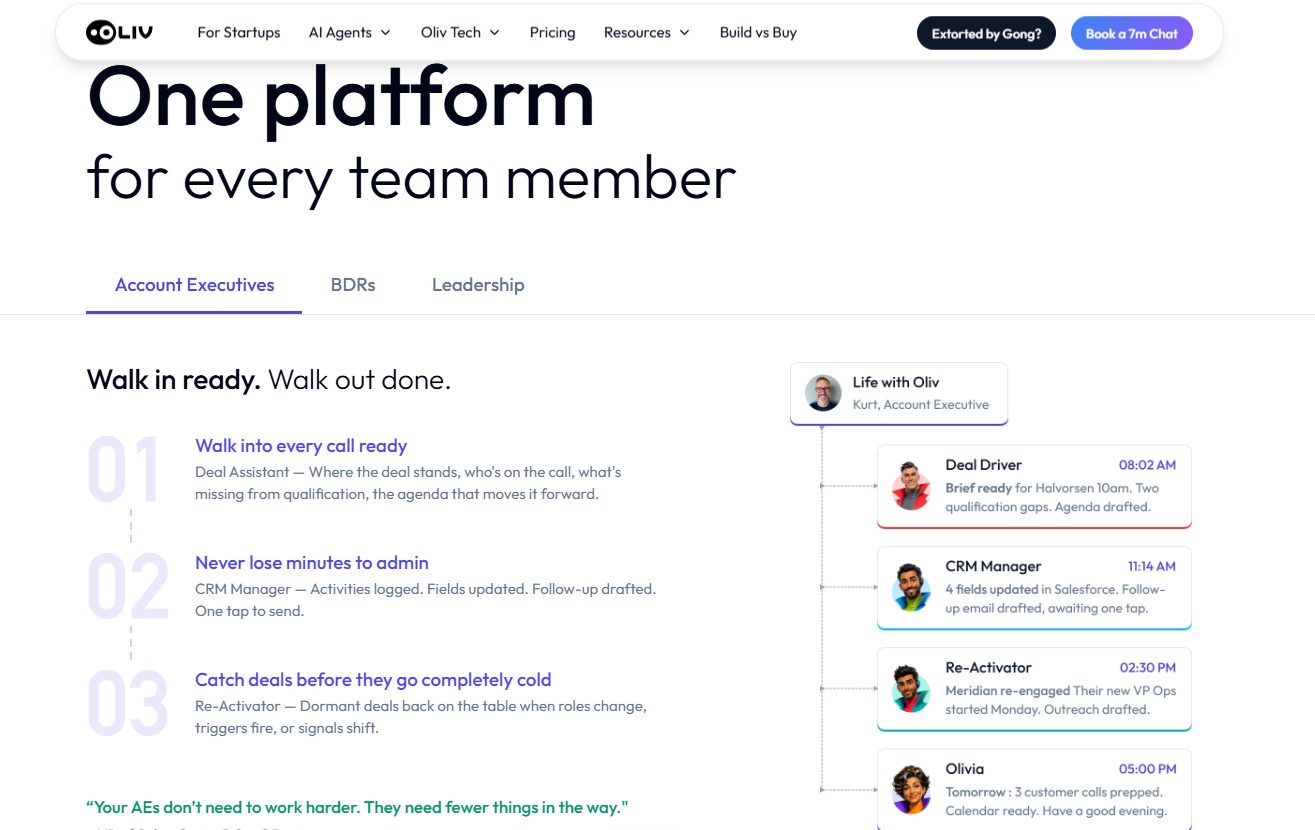
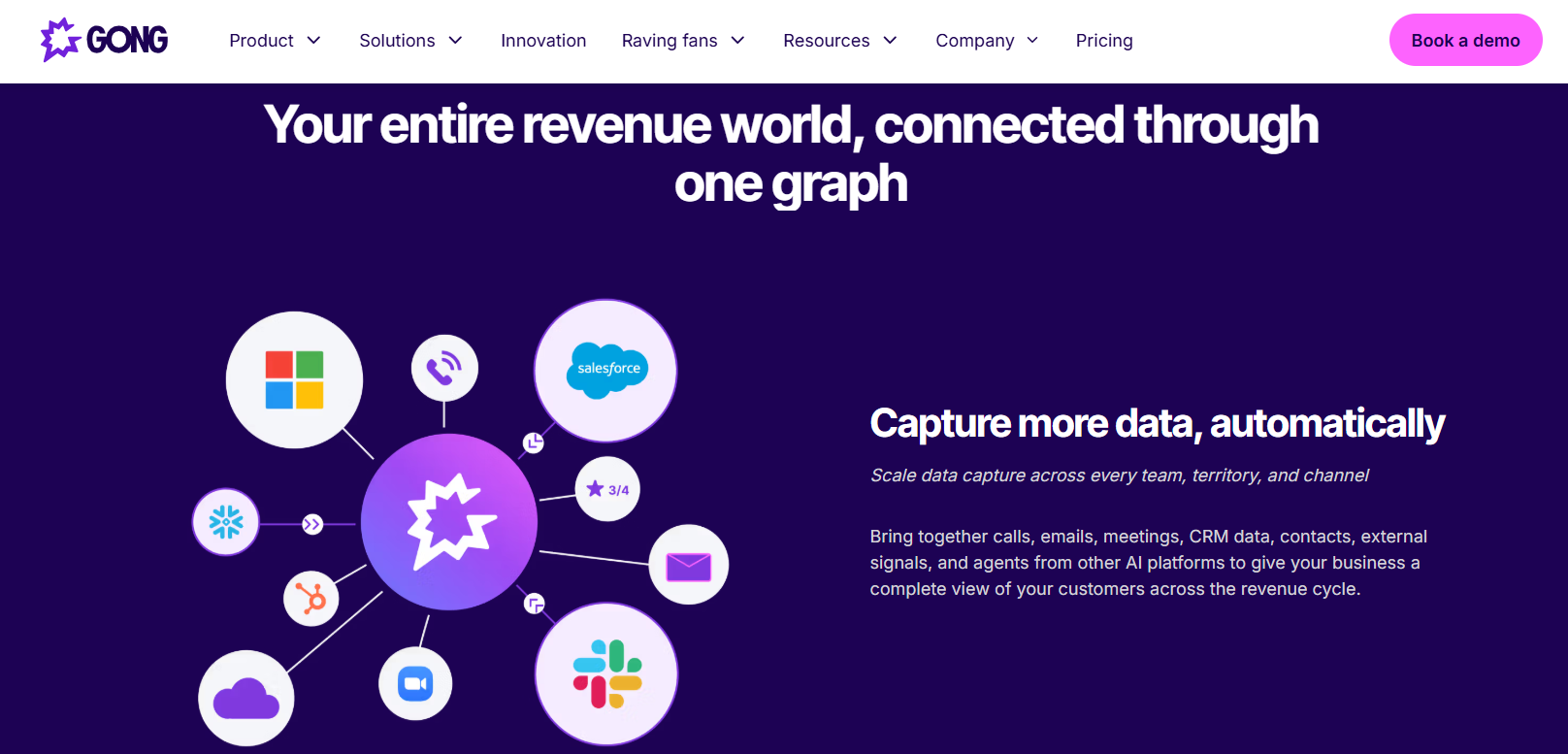
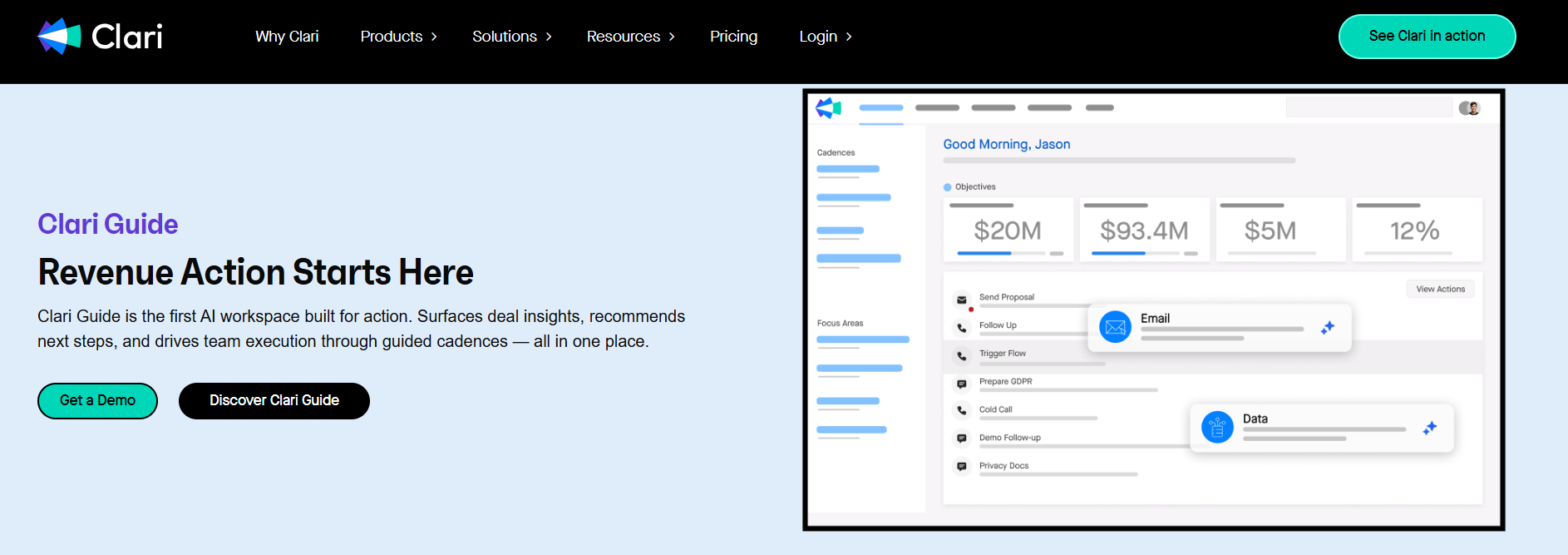

.png)
.png)
.png)

